


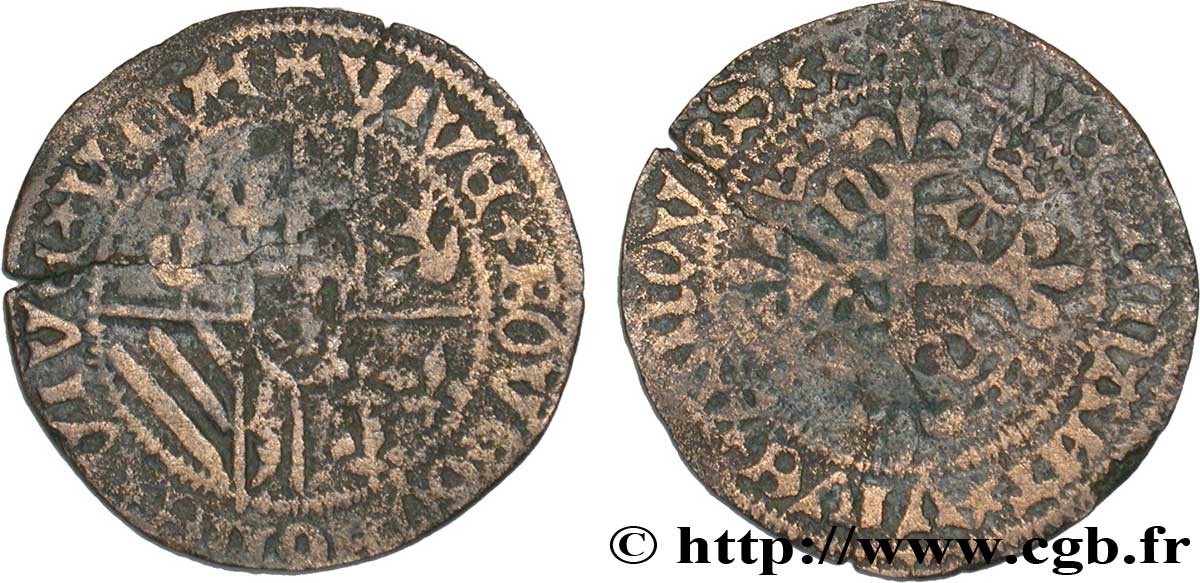
fjt_059279 - BOURGOGNE (DUCS DE ...) DUCS DE BOURGOGNE s.l.
No disponible.
Artículo vendido en nuestra tienda
Precio : 100.00 €
Artículo vendido en nuestra tienda
Precio : 100.00 €
Tipo : DUCS DE BOURGOGNE
Fecha: s.l.
Metal: latón
Diámetro: 24,5 mm
Peso: 3,33 g.
Canto: lisse
Grado de rareza: R2
N° en los catálogos de referencia :
Anverso
Titulatura del anverso: + VIVE * BOVRGOHGHE * VIVE * VIVE.
Descripción del anverso: Armes parties de Bourgogne dans le champ.
Reverso
Titulatura del reverso: + VIVE * AMANT * VIVE * AMOVRS **.
Descripción del reverso: Croix fleurdelisée, cantonné des lettres A, M, E et N couronnées.
Comentario
Nous avions dans un premier temps attribué ce jeton à Jean sans Peur mais cette attribution semble impossible dans la mesure où les armoiries figurées à l'avers n'ont été utilisées que par ses trois successeurs, à savoir Philippe le Bon, Charles le Téméraire et Marie de Bourgogne. Cet exemplaire ne peut donc pas être antérieur à 1419 comme initialement annoncé et s\'agissant d'un type banalisé il est fort probable que sa production se soit poursuivie au-delà de la fin du règne de Marie (1482), probablement jusque vers les années 1530 - 1540. (Commentaires VAN WAEYENBERGHE Pascal).
We initially attributed this token to John the Fearless, but this attribution seems impossible since the coat of arms on the obverse was only used by his three successors, namely Philip the Good, Charles the Bold, and Mary of Burgundy. This example cannot therefore be earlier than 1419 as initially announced, and since it is a commonplace type, it is highly likely that its production continued beyond the end of Mary's reign (1482), probably until around the 1530s and 1540s. (Comments VAN WAEYENBERGHE Pascal)
We initially attributed this token to John the Fearless, but this attribution seems impossible since the coat of arms on the obverse was only used by his three successors, namely Philip the Good, Charles the Bold, and Mary of Burgundy. This example cannot therefore be earlier than 1419 as initially announced, and since it is a commonplace type, it is highly likely that its production continued beyond the end of Mary's reign (1482), probably until around the 1530s and 1540s. (Comments VAN WAEYENBERGHE Pascal)
Historial
BOURGOGNE (DUCS DE ...)
Borgoña es un ducado creado a finales del siglo IX. y gobernado por la casa robertiana. En 1364, el ducado pasó a Philippe le Hardi, cuarto hijo de Jean le Bon. Rápidamente, el ducado se convirtió en uno de los estados más prósperos de Europa occidental. Philippe le Bold (1364-1404) y luego Jean sans Peur (1404-1419) intentaron desempeñar un papel en Francia durante las crisis del reinado de Carlos VI. Philippe le Bon (1419-1467) continuó esta política uniendo fuerzas con los ingleses. Se hizo cargo a partir de 1435 (Tratado de Arras) de su Estado que se había vuelto cada vez más importante a través de la adquisición de Flandes, Artois, Franche-Comté, Brabant, Hainaut, Holanda, etc. mientras llevaba una hábil vida política y artística. Carlos el Temerario (1467-1477) trató de ampliar aún más su ducado, pero su estado fue desmantelado a su muerte y Borgoña propiamente dicha regresó a Francia, mientras que las demás posesiones pasaron a los Habsburgo a través del matrimonio de María, hija del Temerario, con Maximiliano. I.
 Informar de un error
 Imprimir la página
 Comparte mi selección
 Haz una pregunta
 Consignar / vender
Productos que has visto recientemente

CLAUDIO II EL GÓTICO Antoninien BC+
5.00 €
cgbfr.es numismàtica


