


bpv_173800 - CARACALLA Tétradrachme syro-phénicien
No disponible.
Artículo vendido en nuestra tienda (2014)
Precio : 170.00 €
Artículo vendido en nuestra tienda (2014)
Precio : 170.00 €
Tipo : Tétradrachme syro-phénicien
Fecha: 215-217
Nombre del taller / ciudad: Berytus, Phénicie
Metal: vellón
Diámetro: 25 mm
Eje de acuñación: 12 h.
Peso: 13,31 g.
Comentarios sobre el estado de conservación:
Minime usure, bon centrage, belle frappe
N° en los catálogos de referencia :
Anverso
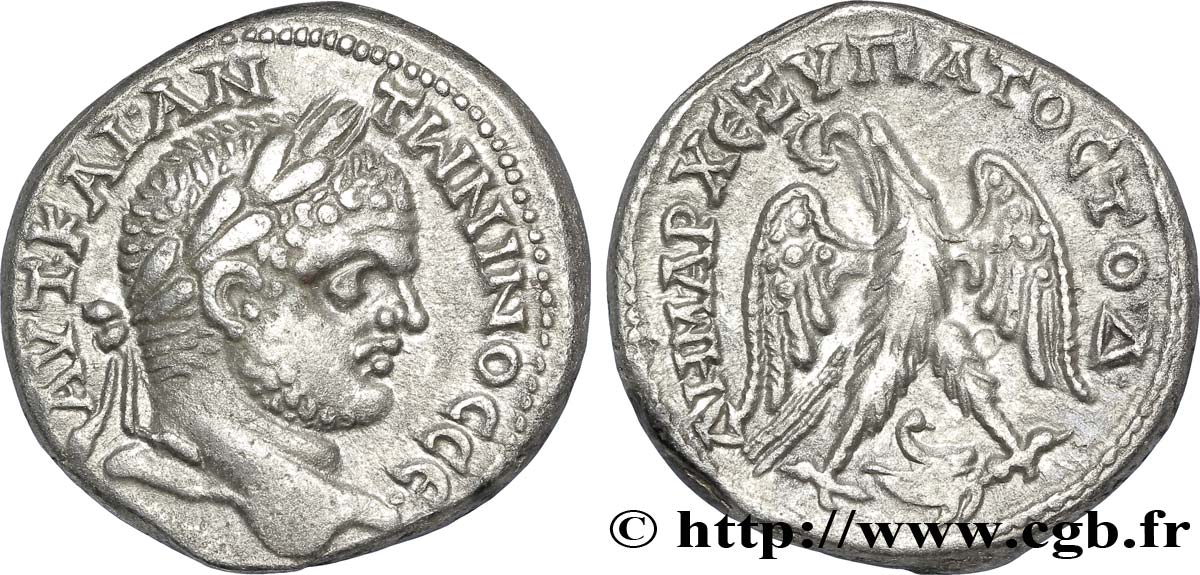
Descripción del anverso: Tête laurée de Caracalla à droite, vu de trois quarts en arrière, l’un des deux rubans de la couronne laurée descendant sur l’épaule (O*).
Leyenda del anverso: AUT. KAI. AN-TwNINOS SE, (Autokrator Kaisar Antwninos Sebastos)
Traducción del anverso: (L'empereur césar Antonin auguste).
Reverso
Descripción del reverso: Aigle debout à droite, les ailes déployées, la tête et la queue tournées à gauche, tenant dans son bec une couronne feuillée ; entre les pattes, la poupe et les rames-gouvernails d’un navire allant à droite.
Leyenda del reverso: DHMARC EX UPATOS TO D
Traducción del reverso: (Revêtu de la puissance tribunitienne consul pour la quatrième fois).
Comentario
Les tétradrachmes attribués à Beyrouth, Berytus, se répartissent en deux grandes séries car en deux symboles. Tout d’abord, la proue de navire à droite, importante série en volume, plusieurs graveurs différents, tant pour les avers que pour les revers, aucune variation du type, pas de frappe pour Macrin ni pour Diaduménien. Par ailleurs aucune preuve factuelle qu’il s’agisse bien de frappes pour Beyrouth : ce ne sont pas les ports qui manquent dans la région et nous n’avons trouvé aucun lien avec les bronzes de la ville. Remarquons pourtant que la poupe qui est représentée avec ses deux gouvernails (notons une erreur dans le Prieur, qui dit prow donc proue alors qu’il s’agit de la poupe d’un navire) semble bien celle d’un navire de commerce, très rond de coque, et non pas d’un navire de guerre, encore moins d’une galère. L’émission serait donc celle d’un port de commerce plutôt que d’un port militaire comme Laodicée ou Séleucie.
L’autre série, avec le dauphin et le trident, excessivement rare, correspond parfaitement à la ville tant pour le symbole, que l’on retrouve sur des bronzes, que pour les graveurs des portraits, que l’on retrouve aussi sur des bronzes.
Peut-on imaginer que les frappes à la poupe de navire furent les taxes payées par l’administration du port de Beyrouth ? Mais alors, pourquoi aucune frappe pour Macrin, qui a bien dû lever des fonds pour payer la rançon de la Pax Fundata cum Persis ?
On note que les sigma sont gravés en C.
Dans la base TSP maintenue par Michel Prieur, soixante et onze exemplaires sont maintenant répertoriés. Notre exemplaire, qui provient de la trouvaille dite de Julia Hoard 1995, est le 1292_051.
The tetradrachms attributed to Beirut, Berytus, are divided into two large series because of two symbols. First of all, the ship's prow on the right, a large series in volume, several different engravers, both for the obverse and the reverse, no variation of the type, no strike for Macrinus or for Diadumenian. Furthermore, there is no factual evidence that these were strikes for Beirut: there is no shortage of ports in the region and we have found no link with the bronzes of the city.. Let us note, however, that the stern which is represented with its two rudders (let us note an error in the Prior, who says prow whereas it is the stern of a ship) seems indeed that of a merchant ship, very round hull, and not of a warship, still less of a galley. The issue would therefore be that of a commercial port rather than a military port like Laodicea or Seleucia..
The other series, with the dolphin and the trident, extremely rare, corresponds perfectly to the city both for the symbol, which is found on bronzes, and for the engravers of the portraits, which are also found on bronzes..
Can we imagine that the strikes on the stern of the ship were the taxes paid by the administration of the port of Beirut? But then, why no strikes for Macrinus, who must have raised funds to pay the ransom of the Pax Fundata cum Persis? We note that the sigmas are engraved in C.
In the TSP database maintained by Michel Prieur, seventy-one examples are now listed.. Our example, which comes from the so-called Julia Hoard 1995 find, is 1292_051
L’autre série, avec le dauphin et le trident, excessivement rare, correspond parfaitement à la ville tant pour le symbole, que l’on retrouve sur des bronzes, que pour les graveurs des portraits, que l’on retrouve aussi sur des bronzes.
Peut-on imaginer que les frappes à la poupe de navire furent les taxes payées par l’administration du port de Beyrouth ? Mais alors, pourquoi aucune frappe pour Macrin, qui a bien dû lever des fonds pour payer la rançon de la Pax Fundata cum Persis ?
On note que les sigma sont gravés en C.
Dans la base TSP maintenue par Michel Prieur, soixante et onze exemplaires sont maintenant répertoriés. Notre exemplaire, qui provient de la trouvaille dite de Julia Hoard 1995, est le 1292_051.
The tetradrachms attributed to Beirut, Berytus, are divided into two large series because of two symbols. First of all, the ship's prow on the right, a large series in volume, several different engravers, both for the obverse and the reverse, no variation of the type, no strike for Macrinus or for Diadumenian. Furthermore, there is no factual evidence that these were strikes for Beirut: there is no shortage of ports in the region and we have found no link with the bronzes of the city.. Let us note, however, that the stern which is represented with its two rudders (let us note an error in the Prior, who says prow whereas it is the stern of a ship) seems indeed that of a merchant ship, very round hull, and not of a warship, still less of a galley. The issue would therefore be that of a commercial port rather than a military port like Laodicea or Seleucia..
The other series, with the dolphin and the trident, extremely rare, corresponds perfectly to the city both for the symbol, which is found on bronzes, and for the engravers of the portraits, which are also found on bronzes..
Can we imagine that the strikes on the stern of the ship were the taxes paid by the administration of the port of Beirut? But then, why no strikes for Macrinus, who must have raised funds to pay the ransom of the Pax Fundata cum Persis? We note that the sigmas are engraved in C.
In the TSP database maintained by Michel Prieur, seventy-one examples are now listed.. Our example, which comes from the so-called Julia Hoard 1995 find, is 1292_051
Historial
CARACALLA
(27/05/196-8/04/217)
Augusto
Tras el asesinato de Geta, Caracalla decretó la "damnatio memoriæ" de su hermano. La "Constitución Antoniniana" fue promulgada en 212. Todos los habitantes del Imperio se convirtieron en ciudadanos romanos. Al año siguiente emprendió una campaña en Germania y obtuvo muchas victorias sobre los alemanes, los jápigos y los godos. Recibió el título de "Germánico". El final del reinado estuvo marcado en 215 por la Reforma Monetaria y la creación de Antoninianus. Caracalla inicia una última campaña contra los partos. Es asesinado después de haber celebrado su vicennalia.
 Informar de un error
 Imprimir la página
 Comparte mi selección
 Haz una pregunta
 Consignar / vender
Artículos relacionados

 Descriptivo



cgbfr.es numismàtica


