


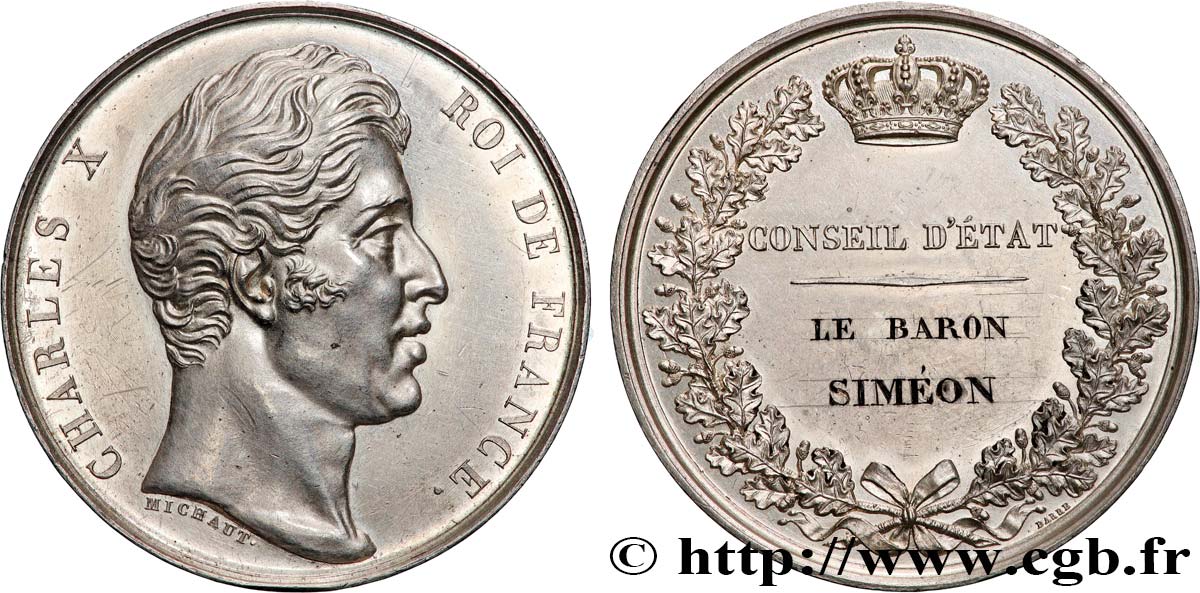
Live auction - fme_895919 - CARLOS X Médaille, Conseil d’État, Joseph Jérôme, comte Siméon
Usted debe firmar y ser un comprador aprobado para pujar, Inicia sesión para pujar. Las cuentas están sujetas a la aprobación y el proceso de aprobación se alcanzan dentro de las 48 horas. No espere hasta el día en una venta se cierra el registro.Al hacer una oferta en este artículo usted está firmando un contrato jurídicamente vinculante para comprar este artículo y haga clic en «oferta» constituye una aceptación de los términos de uso de live auctions de cgb.fr.
La subasta debe ser colocado en euros enteros cantidades venta only.The se cerrará en el momento en la descripción del artículo, no se ejecutarán las ofertas recibidas en el sitio después de la hora de cierre. Veces Transmition pueden variar y las ofertas pueden ser rechazadas si espera a los últimos segundos. Para más información envie el FAQ Live auction.
Las ofertas ganadoras estarán sometidas a un 18% IVA incluido por gastos de participación a la venta.
Las ofertas ganadoras estarán sometidas a un 18% IVA incluido por gastos de participación a la venta.
| Valoración : | 200 € |
| Precio : | 450 € |
| Oferta más alta : | 450 € |
| Fecha de fin de la venta : | 13 febrero 2024 17:01:11 |
| participantes : | 4 participantes |
Tipo : Médaille, Conseil d’État, Joseph Jérôme, comte Siméon
Fecha: n.d.
Metal: plata
Diámetro: 41 mm
Eje de acuñación: 12 h.
Acuñador MICHAUT Auguste-François (1786-1879)
Peso: 41,47 g.
Canto: lisse
Cuño: sans poinçon
Comentarios sobre el estado de conservación:
Patine hétérogène, présentant des frottements dans les champs. Présence de quelques rayures. Beaux reliefs au revers. Quelques petits coups sur la tranche
Anverso
Titulatura del anverso: CHARLES X - ROI DE FRANCE..
Descripción del anverso: Tête nue de profil à droite, signé : MICHAUT..
Reverso
Titulatura del reverso: CONSEIL D’ETAT / - / LE BARON / SIMEON.
Descripción del reverso: Légende en 3 lignes dans une couronne de chêne, sommée d’une couronne. Signé : BARRE.
Comentario
La médaille a été remise à Joseph Jérôme, comte Siméon (1749-1842). Né à Aix-en-Provence, il deviendra professeur de droit à l’université d’Aix-en-Provence en 1778, assesseur de Provence en 1783, il perd sa chaire sous la Révolution et prend part au mouvement fédéraliste du Midi en 1793.
D’abord réfugié en Italie, puis de retour à Marseille, il sera député au Conseil des Cinq-Cents en 1795. Condamné à la déportation puis prisonnier, il sera libéré lors du coup d'État du 18 brumaire. Refusant sa nomination de préfet de la Marne, il sera nommé tribun et prend part à la préparation du Code civil. Conseiller d'État (1804), il devient membre du conseil de régence en 1807 puis ministre de l'Intérieur et président du Conseil d'État du roi Jérôme de Westphalie.
Il sera ensuite préfet du Nord (1814-1815), il siège aussi à le Chambre des représentants des Cent-Jours, puis à la « Chambre introuvable » à la Seconde Restauration et reprend place au Conseil d’État en 1815. Il sera également ministre de l’Intérieur (1820-1821), pair de France à partir de 1821 et sera le premier président de la Cour des comptes (1837-1839).
The medal was awarded to Joseph Jérôme, Count Siméon (1749-1842). Born in Aix-en-Provence, he became a professor of law at the University of Aix-en-Provence in 1778, assessor of Provence in 1783, he lost his chair during the Revolution and took part in the federalist movement of the South in 1793. First a refugee in Italy, then returning to Marseille, he was a deputy in the Council of Five Hundred in 1795. Sentenced to deportation then prisoner, he was freed during the coup d'état of 18 Brumaire. Refusing his appointment as prefect of the Marne, he was appointed tribune and took part in the preparation of the Civil Code. Councilor of State (1804), he became a member of the Regency Council in 1807 then Minister of the Interior and President of the Council of State of King Jerome of Westphalia. He was then Prefect of the North (1814-1815), he also sat in the Chamber of Representatives of the Hundred Days, then in the \\\"Introuvable Chamber\\\" during the Second Restoration and took his place again in the Council of State in 1815. He was also Minister of the Interior (1820-1821), Peer of France from 1821 and was the first President of the Court of Auditors (1837-1839)
D’abord réfugié en Italie, puis de retour à Marseille, il sera député au Conseil des Cinq-Cents en 1795. Condamné à la déportation puis prisonnier, il sera libéré lors du coup d'État du 18 brumaire. Refusant sa nomination de préfet de la Marne, il sera nommé tribun et prend part à la préparation du Code civil. Conseiller d'État (1804), il devient membre du conseil de régence en 1807 puis ministre de l'Intérieur et président du Conseil d'État du roi Jérôme de Westphalie.
Il sera ensuite préfet du Nord (1814-1815), il siège aussi à le Chambre des représentants des Cent-Jours, puis à la « Chambre introuvable » à la Seconde Restauration et reprend place au Conseil d’État en 1815. Il sera également ministre de l’Intérieur (1820-1821), pair de France à partir de 1821 et sera le premier président de la Cour des comptes (1837-1839).
The medal was awarded to Joseph Jérôme, Count Siméon (1749-1842). Born in Aix-en-Provence, he became a professor of law at the University of Aix-en-Provence in 1778, assessor of Provence in 1783, he lost his chair during the Revolution and took part in the federalist movement of the South in 1793. First a refugee in Italy, then returning to Marseille, he was a deputy in the Council of Five Hundred in 1795. Sentenced to deportation then prisoner, he was freed during the coup d'état of 18 Brumaire. Refusing his appointment as prefect of the Marne, he was appointed tribune and took part in the preparation of the Civil Code. Councilor of State (1804), he became a member of the Regency Council in 1807 then Minister of the Interior and President of the Council of State of King Jerome of Westphalia. He was then Prefect of the North (1814-1815), he also sat in the Chamber of Representatives of the Hundred Days, then in the \\\"Introuvable Chamber\\\" during the Second Restoration and took his place again in the Council of State in 1815. He was also Minister of the Interior (1820-1821), Peer of France from 1821 and was the first President of the Court of Auditors (1837-1839)
Historial
CARLOS X
(16/09/1824-2/08/1830)
Carlos X, nieto de Luis XV y hermano menor de Luis XVI, es conocido como Comte d'Artois. Sucedió a Luis XVIII el 16 de septiembre de 1824.. Su reinado comienza con medidas liberales sin seguimiento. Carlos X es el último rey coronado en Reims, 29 de mayo de 1825. Deja el gobierno a Villèle que toma medidas reaccionarias como la ley de compensación a los emigrantes de mil millones de francos oro o la destitución de la Guardia Nacional. A pesar de la disolución de la Cámara en 1821, la oposición liberal se reforzó y, en enero de 1828, Villèle fue sustituida por Martignac que trató de apaciguar. Rápidamente despedido en agosto de 1829, Martignac fue reemplazado por un representante de los ultras, Polignac.. El rey disuelve la Cámara el 16 de mayo de 1830 pero la nueva cámara elegida en julio vuelve a tener mayoría liberal. Carlos X promulga entonces cuatro ordenanzas que pretenden limitar los poderes y libertades de la Cámara y tienden a suspender la carta de 1814.. Esto provoca la revolución del 27/29 de julio, más conocida como los "Trois Glorieuses". El 2 de agosto de 1830, Carlos X abdicó en favor de su nieto Enrique V, tras nombrar a Luis Felipe lugarteniente general del reino..
 Informar de un error
 Imprimir la página
 Comparte mi selección
 Haz una pregunta
 Consignar / vender
Artículos relacionados

 Descriptivo


Productos que has visto recientemente

5 Francs NOUVELLE CALÉDONIE 1943 P.58 SC+
130.00 €
FRANCIA KIT DE PRÉ-ALIMENTATION 40 PIÈCES (1999/2001) n.d. SC
40.00 €

5 francs Semeuse, argent, Tranche Fautée 1963 Paris F.340/7 var. MBC+
500.00 €

Série Brillant Universel 1991 F.5200/9 FDC
450.00 €

CARLOS X Médaille, Conseil d’État, Joseph Jérôme, comte Siméon MBC+
450.00 €
Essai de 5 centimes Épi 1961 Paris F.124/2 SC
98.00 €
cgbfr.es numismàtica


