


v23_0917 - CHALON - SUR - SAÔNE (CABILONNUM) Triens, monétaire VINTRIO

MONNAIES 23 (2004)
Precio de inicio : 1 500.00 €
Valoración : 2 500.00 €
Precio realizado : 2 020.00 €
Número de ofertas : 3
Oferta más alta : 2 260.00 €
Precio de inicio : 1 500.00 €
Valoración : 2 500.00 €
Precio realizado : 2 020.00 €
Número de ofertas : 3
Oferta más alta : 2 260.00 €
Tipo : Triens, monétaire VINTRIO
Fecha: (VIIe siècle)
Nombre del taller / ciudad: 71 - Chalon-sur-Saône
Metal: oro
Diámetro: 12 mm
Eje de acuñación: 6 h.
Peso: 1,23 g.
Grado de rareza: R2
Comentarios sobre el estado de conservación:
Monnaie bien frappée et d’un bon centrage. Légendes presque complètes, et en bord de flan. Un petit coup au revers, sur la dernière lettre. Le flan est fendu à 12 heures au droit
N° en los catálogos de referencia :
Pedigrí:
Cet exemplaire aurait été acheté en mai 1959
Anverso
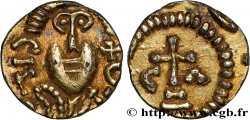
Titulatura del anverso: +CABIL-ONNO FIT.
Descripción del anverso: Buste à droite, diadème de perles sommé d’un croissant et attaché par trois rubans terminés par des globules ; manteau avec anneau d’attache à l’angle gauche et globules à l’angle droit.
Reverso
Titulatura del reverso: +[VNINTRI]OMON.
Descripción del reverso: Croix latine sur deux degrés, accostée de CA, dans un diadème de perles avec un anneau centré.
Comentario
Cette monnaie appartient au quatrième groupe du monnayage mérovingien attribué à Chalon-sur-Saône. Avec la croix (non chrismée) reposant sur l’anneau centré, ce triens est comparable au n° 1167 du Belfort et au n° 46 et 54 de l’ouvrage de Ponton d’Amécourt.
Le monnayage de Cabilonnum est divisé en plusieurs groupes. Le premier regroupe les monnaies épiscopales (STEPHANVS EPISCOPVS). Le deuxième est dit "de transition", avec des monétaires tels que NONNVS, PRISCVS, DOMNOLVS, DOMNITIVS, BONNASIVS et CHLOTHARIVS. Le troisième est pour DOMNITTVS, BAIVLFVS, BAIO, BAVDOMERE, RIGNOALDVS, FRATERNVS et ABBO. Le quatrième groupe est principalement constitué de monnaies de VVINTRIO dont le Belfort recense 45 numéros (n° 1152 - 1196). Ce monétaire est ensuite associé à BONEFACIVS puis à BETTO. Le cinquième groupe reprend les pièces imitées des types de VVINTRO et du quatrième groupe. Le dernier groupe (huitième au Belfort) regroupe les monnaies de cuivre et d'argent sur lesquelles ont retrouve le nom de certains monétaires mentionnés sur l'or. Comme le faisait remarquer le Vicomte Ponton d'Amécourt, "Wintrio a émis à lui seul presque autant de monnaies que tous les autres monétaires de Chalon réunis ; ses coins varient à l'infini dans un cadre fort restreint du reste, dont les caractères généraux sont toujours les mêmes : au droit un buste de profil regardant à droite ; au revers une croix accostée des lettres CA, dans un diadème de perles." Selon l'auteur, Wintrio pourrait être considéré comme le monétaire de Clotaire. Le monnayage de Wintrio est lui-même divisé en plusieurs périodes, selon le type de vêtement, de nœud du diadème. Wintrio s'est adjoint à plusieurs monétaires qui ont signé avec lui. Sur un exemplaire (unique en 1866 et dont la légende du monétaire est incomplète), Wintrio "se pose en personnage, ne s'attribuant plus la qualité de monétaire ; il inscrit son nom magistralement au droit de la monnaie tandis que le monétaire signe au revers avec la qualification de monétaire.
This coin belongs to the fourth group of Merovingian coinage attributed to Chalon-sur-Saône. With the cross (not chrismated) resting on the centered ring, this triens is comparable to n° 1167 of Belfort and to n° 46 and 54 of the work of Ponton d'Amécourt.
The coinage of Cabilonnum is divided into several groups. The first includes episcopal coins (STEPHANVS EPISCOPVS). The second is called \\\"transitional\\\", with coins such as NONNVS, PRISCVS, DOMNOLVS, DOMNITIVS, BONNASIVS and CHLOTHARIVS. The third is for DOMNITTVS, BAIVLFVS, BAIO, BAVDOMERE, RIGNOALDVS, FRATERNVS and ABBO. The fourth group is mainly made up of VVINTRIO coins, of which Belfort lists 45 numbers (n° 1152 - 1196). This coin is then associated with BONEFACIVS then with BETTO. The fifth group includes the imitated pieces of the VVINTRO types and the fourth group. The last group (eighth in Belfort) includes copper and silver coins on which we find the name of certain mints mentioned on the gold. As Viscount Ponton d'Amécourt noted, \\\"Wintrio alone issued almost as many coins as all the other mints of Chalon combined; his dies vary infinitely within a very restricted framework, the general characteristics of which are always the same: on the obverse a bust in profile looking to the right; on the reverse a cross flanked by the letters CA, in a pearl diadem. \\\"According to the author, Wintrio could be considered as Clotaire's coiner. The coinage of Wintrio is itself divided into several periods, according to the type of garment, knot of the diadem. Wintrio has joined forces with several monetaries who have signed with him. On one example (unique in 1866 and whose mint legend is incomplete), Wintrio \\\"poses himself as a character, no longer attributing to himself the quality of mint; he inscribes his name masterfully on the obverse of the coin while the mint signs on the reverse with the qualification of mint
Le monnayage de Cabilonnum est divisé en plusieurs groupes. Le premier regroupe les monnaies épiscopales (STEPHANVS EPISCOPVS). Le deuxième est dit "de transition", avec des monétaires tels que NONNVS, PRISCVS, DOMNOLVS, DOMNITIVS, BONNASIVS et CHLOTHARIVS. Le troisième est pour DOMNITTVS, BAIVLFVS, BAIO, BAVDOMERE, RIGNOALDVS, FRATERNVS et ABBO. Le quatrième groupe est principalement constitué de monnaies de VVINTRIO dont le Belfort recense 45 numéros (n° 1152 - 1196). Ce monétaire est ensuite associé à BONEFACIVS puis à BETTO. Le cinquième groupe reprend les pièces imitées des types de VVINTRO et du quatrième groupe. Le dernier groupe (huitième au Belfort) regroupe les monnaies de cuivre et d'argent sur lesquelles ont retrouve le nom de certains monétaires mentionnés sur l'or. Comme le faisait remarquer le Vicomte Ponton d'Amécourt, "Wintrio a émis à lui seul presque autant de monnaies que tous les autres monétaires de Chalon réunis ; ses coins varient à l'infini dans un cadre fort restreint du reste, dont les caractères généraux sont toujours les mêmes : au droit un buste de profil regardant à droite ; au revers une croix accostée des lettres CA, dans un diadème de perles." Selon l'auteur, Wintrio pourrait être considéré comme le monétaire de Clotaire. Le monnayage de Wintrio est lui-même divisé en plusieurs périodes, selon le type de vêtement, de nœud du diadème. Wintrio s'est adjoint à plusieurs monétaires qui ont signé avec lui. Sur un exemplaire (unique en 1866 et dont la légende du monétaire est incomplète), Wintrio "se pose en personnage, ne s'attribuant plus la qualité de monétaire ; il inscrit son nom magistralement au droit de la monnaie tandis que le monétaire signe au revers avec la qualification de monétaire.
This coin belongs to the fourth group of Merovingian coinage attributed to Chalon-sur-Saône. With the cross (not chrismated) resting on the centered ring, this triens is comparable to n° 1167 of Belfort and to n° 46 and 54 of the work of Ponton d'Amécourt.
The coinage of Cabilonnum is divided into several groups. The first includes episcopal coins (STEPHANVS EPISCOPVS). The second is called \\\"transitional\\\", with coins such as NONNVS, PRISCVS, DOMNOLVS, DOMNITIVS, BONNASIVS and CHLOTHARIVS. The third is for DOMNITTVS, BAIVLFVS, BAIO, BAVDOMERE, RIGNOALDVS, FRATERNVS and ABBO. The fourth group is mainly made up of VVINTRIO coins, of which Belfort lists 45 numbers (n° 1152 - 1196). This coin is then associated with BONEFACIVS then with BETTO. The fifth group includes the imitated pieces of the VVINTRO types and the fourth group. The last group (eighth in Belfort) includes copper and silver coins on which we find the name of certain mints mentioned on the gold. As Viscount Ponton d'Amécourt noted, \\\"Wintrio alone issued almost as many coins as all the other mints of Chalon combined; his dies vary infinitely within a very restricted framework, the general characteristics of which are always the same: on the obverse a bust in profile looking to the right; on the reverse a cross flanked by the letters CA, in a pearl diadem. \\\"According to the author, Wintrio could be considered as Clotaire's coiner. The coinage of Wintrio is itself divided into several periods, according to the type of garment, knot of the diadem. Wintrio has joined forces with several monetaries who have signed with him. On one example (unique in 1866 and whose mint legend is incomplete), Wintrio \\\"poses himself as a character, no longer attributing to himself the quality of mint; he inscribes his name masterfully on the obverse of the coin while the mint signs on the reverse with the qualification of mint
Historial
CHALON - SUR - SAÔNE (CABILONNUM)
(siglo VII)
El reino de Borgoña se anexó al reino franco después de la victoria de Autun en 534. Borgoña tiene un monarca independiente hasta 613 a la muerte de Thierry II. Después del asesinato de Sigeberto II en 613 por Clotario II, Borgoña se incorporó al reino de Neustria. Saint-Léger, obispo de Autun (616-678), fue alcalde del Palacio. El gobierno real está asegurado por el palacio, que es más una institución que un lugar. Hay tres capitales: París (Neustria), Metz (Austrasia) y Chalon-sur-Saône (Borgoña). Todavía hay un palacio que continúa funcionando después de que Clotario II restableciera la unidad. El palacio es un símbolo de la autonomía del reino. Clotario II gobierna desde París pero todavía hay un palacio en Metz y Chalon. La acuñación de oro de Chalon-sur-Saône fue sin duda la más abundante del período merovingio..
 Informar de un error
 Imprimir la página
 Comparte mi selección
 Haz una pregunta
 Consignar / vender
Artículos relacionados
 Descriptivo



Productos que has visto recientemente
50 Mark SARRE FRANCIA 1947 VF.48.02 BC+
2001.00 €

50000 Livres Spécimen LIBANO 1999 P.077s FDC
50.00 €

1000 Francs type 1974 CAMERúN 1982 A.154f FDC
158.00 €

CONSTANCIO I CLORO Follis ou nummus MBC+
52.00 €

MARCO AURELIO Dupondius, (MB, Æ 24) BC
12.00 €
JOVIANO Maiorina ou nummus MBC
15.00 €
cgbfr.es numismàtica


