


- Accueil
- >
- >
E-auction 468-379771 - fme_736828 - THE 100 GREATEST MASTERPIECES Médaille, La brise se lève de Homer
Usted debe firmar y ser un comprador aprobado para pujar, Inicia sesión para pujar. Las cuentas están sujetas a la aprobación y el proceso de aprobación se alcanzan dentro de las 48 horas. No espere hasta el día en una venta se cierra el registro.Al hacer una oferta en este artículo usted está firmando un contrato jurídicamente vinculante para comprar este artículo y haga clic en «oferta» constituye una aceptación de los términos de uso de e-auctions de cgb.fr.
La subasta debe ser colocado en euros enteros cantidades venta only.The se cerrará en el momento en la descripción del artículo, no se ejecutarán las ofertas recibidas en el sitio después de la hora de cierre. Veces Transmition pueden variar y las ofertas pueden ser rechazadas si espera a los últimos segundos. Para más información envie el FAQ.
SIN GASTOS PARA LOS COMPRADORES.
SIN GASTOS PARA LOS COMPRADORES.
| Valoración : | 55 € |
| Precio : | 35 € |
| Oferta más alta : | 35 € |
| Fecha de fin de la venta : | 04 abril 2022 18:15:00 |
| participantes : | 6 participantes |
Tipo : Médaille, La brise se lève de Homer
Fecha: 1974
Metal: plata
Milésimas de pureza : 800 ‰
Diámetro: 50,5 mm
Eje de acuñación: 12 h.
Acuñador LUNGER Jane
Peso: 65,79 g.
Canto: lisse + ARGENT 1ER TITRE + losange + 74 + P + CRABE
Cuño: Crabe
Comentarios sobre el estado de conservación:
Traces de manipulation
Anverso
Titulatura del anverso: ANÉPIGRAPHE.
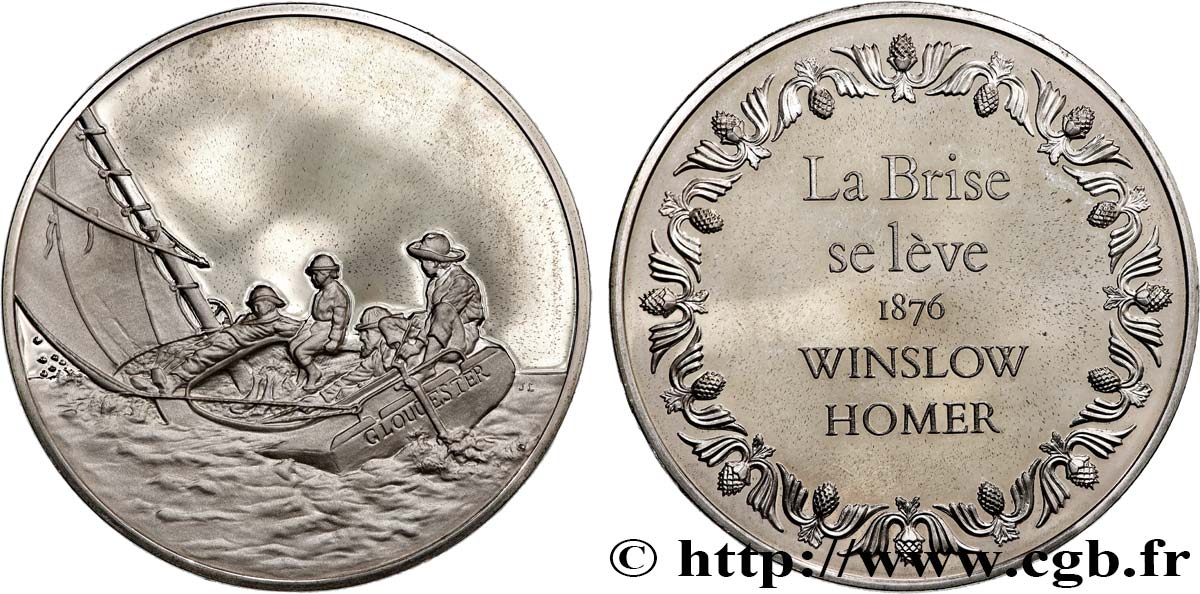
Descripción del anverso: Représentation d’un tableau de Winslow Homer (1876).
Monogramme du graveur.
Reverso
Titulatura del reverso: LA BRISE / SE LÈVE / 1876 / WINSLOW / HOMER.
Descripción del reverso: Légende en 5 lignes entourée d’une frise végétale.
Comentario
Exemplaire issu du médaillier Franklin qui met à l’honneur le tableau de Winslow Homer : La brise se lève (1876). Il est conservé au National Gallery of Art, Washington.
“La brise se lève est une version maritime de La farandole, description de l'innocence heureuse et insouciante de l'enfance. Sur un bateau à voiles, de jeunes garçons participent pour leur plaisir commun à l'occupation insouciante qu'est leur navigation. Un adulte partage pour un instant leur bonheur. La journée est belle. L'air et la mer sont vifs. Du vent gonfle les voiles et l'embarcation vibre et court sur les vagues. La poussée de l'air dans les voiles tend les cordages ; tous les acteurs maîtrisent ensemble un jouet animé par la nature. Ils tirent sur les cordages, ils serrent le gouvernail et ils se portent contre les bords pour maintenir l'embarcation sur sa trajectoire. A l'arrière plan, à droite, un grand navire, toutes voiles dehors, se déplace suivant l'horizon, en contrepoint serein à la lancée diagonale du bateau du premier plan”.
Source: Jules David Prown : La peinture américaine, des origines à l’Armory Show, 1969.
Médaille sculptée par Jane Lunger.
Théoriquement, le poinçon crabe est censé indiquer un titrage à 800 millièmes.
example from the Franklin medallion collection featuring Winslow Homer's painting: The Breeze Rises (1876). It is kept at the National Gallery of Art, Washington.
“The Breeze Rises” is a maritime version of La farandole, a description of the happy and carefree innocence of childhood.. On a sailing boat, young boys participate for their common pleasure in the carefree occupation of sailing.. An adult shares their happiness for a moment. The day is beautiful. The air and the sea are crisp. Wind fills the sails and the boat vibrates and races over the waves. The thrust of the air in the sails tightens the ropes; all the actors together control a toy animated by nature. They pull on the ropes, they tighten the rudder and they lean against the edges to keep the boat on its course.. In the background, on the right, a large ship, with all sails set, moves along the horizon, in serene counterpoint to the diagonal sweep of the boat in the foreground.”.
Source: Jules David Prown: American Painting, From Its Origins to the Armory Show, 1969.
Medal sculpted by Jane Lunger.
Theoretically, the crab hallmark is supposed to indicate a fineness of 800 thousandths.
“La brise se lève est une version maritime de La farandole, description de l'innocence heureuse et insouciante de l'enfance. Sur un bateau à voiles, de jeunes garçons participent pour leur plaisir commun à l'occupation insouciante qu'est leur navigation. Un adulte partage pour un instant leur bonheur. La journée est belle. L'air et la mer sont vifs. Du vent gonfle les voiles et l'embarcation vibre et court sur les vagues. La poussée de l'air dans les voiles tend les cordages ; tous les acteurs maîtrisent ensemble un jouet animé par la nature. Ils tirent sur les cordages, ils serrent le gouvernail et ils se portent contre les bords pour maintenir l'embarcation sur sa trajectoire. A l'arrière plan, à droite, un grand navire, toutes voiles dehors, se déplace suivant l'horizon, en contrepoint serein à la lancée diagonale du bateau du premier plan”.
Source: Jules David Prown : La peinture américaine, des origines à l’Armory Show, 1969.
Médaille sculptée par Jane Lunger.
Théoriquement, le poinçon crabe est censé indiquer un titrage à 800 millièmes.
example from the Franklin medallion collection featuring Winslow Homer's painting: The Breeze Rises (1876). It is kept at the National Gallery of Art, Washington.
“The Breeze Rises” is a maritime version of La farandole, a description of the happy and carefree innocence of childhood.. On a sailing boat, young boys participate for their common pleasure in the carefree occupation of sailing.. An adult shares their happiness for a moment. The day is beautiful. The air and the sea are crisp. Wind fills the sails and the boat vibrates and races over the waves. The thrust of the air in the sails tightens the ropes; all the actors together control a toy animated by nature. They pull on the ropes, they tighten the rudder and they lean against the edges to keep the boat on its course.. In the background, on the right, a large ship, with all sails set, moves along the horizon, in serene counterpoint to the diagonal sweep of the boat in the foreground.”.
Source: Jules David Prown: American Painting, From Its Origins to the Armory Show, 1969.
Medal sculpted by Jane Lunger.
Theoretically, the crab hallmark is supposed to indicate a fineness of 800 thousandths.
Historial
THE 100 GREATEST MASTERPIECES
(1974-1982)
Colección de medallas emitidas por el Medallier en edición limitada. Una vez al mes, al precio de 180 Frs, se enviaba una medalla. Esta colección se realizó entre 1974 y 1982. Cada medalla suele llevar en el borde el punzón estatal que garantiza la acuñación de plata, la marca P de calidad Proof, el año de acuñación y el punzón de Maestro del Medallón..
 Informar de un error
 Imprimir la página
 Comparte mi selección
 Haz una pregunta
 Consignar / vender
Productos que has visto recientemente

PRIX ET RÉCOMPENSES Médaille, Jeunesse Sports et Loisirs EBC
6.00 €
cgbfr.es numismàtica


