


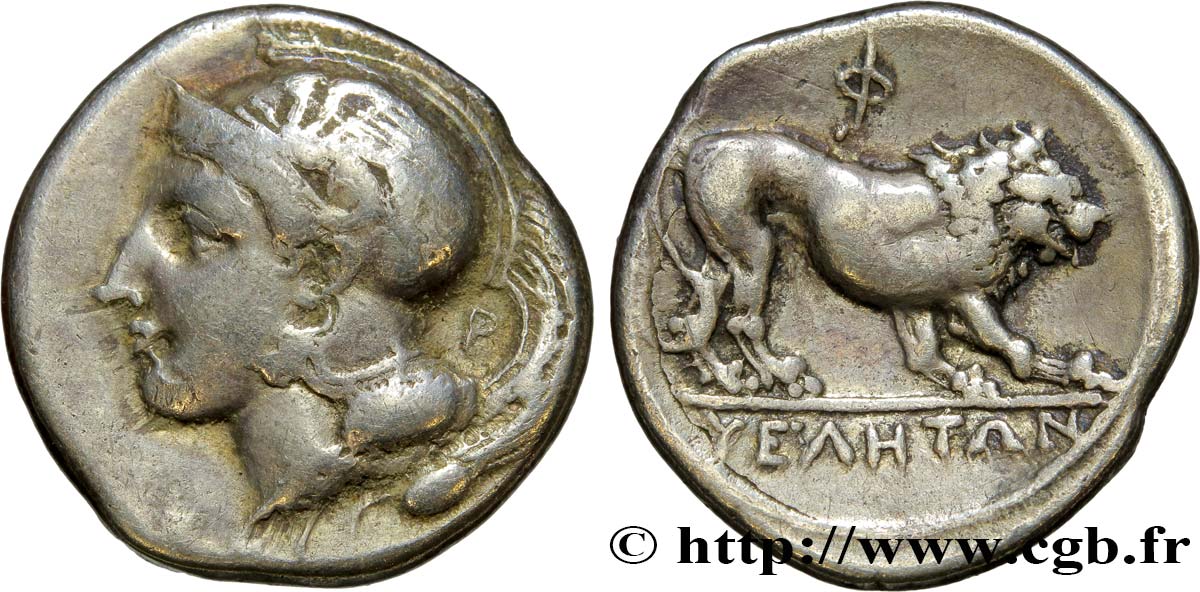
bgr_396300 - LUCANIA - VELIA Nomos, statère ou didrachme
No disponible.
Artículo vendido en nuestra tienda (2016)
Precio : 280.00 €
Artículo vendido en nuestra tienda (2016)
Precio : 280.00 €
Tipo : Nomos, statère ou didrachme
Fecha: c. 365-350/340 AC
Nombre del taller / ciudad: Luncanie, Vélia
Metal: plata
Diámetro: 22 mm
Eje de acuñación: 6 h.
Peso: 7,57 g.
Grado de rareza: R1
Comentarios sobre el estado de conservación:
Exemplaire sur un flan irrégulier bien centré des deux côtés. Beau portrait d’Athéna. Revers bien à la frappe, mais un peu mou. Patine grise superficielle avec des reflets dorés
N° en los catálogos de referencia :
Anverso
Descripción del anverso: Tête d'Athéna à gauche, coiffée du casque attique à cimier avec triple aigrette, orné d’un griffon.
Leyenda del anverso: (RQ)
Reverso
Descripción del reverso: Lion passant à droite .
Leyenda del reverso: UELHTWN/ F
Traducción del reverso: (de Vélia).
Comentario
R. Williams a étudié la dégradation du coin de droit (A/152) et du coin de revers (R/ 203) et a déterminé six phases différentes. Très tôt, le monnayage de Vélia a été décrit comme ayant inspiré la drachme lourde de Marseille (LT. 785-791). Certains l’ont même décrit comme un monnayage symmachique : un lion de Vélia étant l’équivalent de deux lions de Marseille. Aujourd’hui, cette théorie est remise en cause, par G. Depeyrot, non sans arguments, mais avec une certaine acrimonie. Le lion de Vélia a pu servir de modèle à celui de Marseille, mais à quelle date ? La frappe à Vélia commence dans la seconde moitié du Ve siècle avant J.-C. pour se poursuivre jusqu’en 281 avant J.-C. À quel moment les Massaliotes auraient-ils emprunté le lion de Vélia ?.
R. Williams studied the degradation of the obverse die (A/152) and the reverse die (R/203) and identified six different phases. Very early on, the coinage of Velia was described as having inspired the heavy drachma of Marseille (LT. 785-791). Some have even described it as a symmachic coinage: one lion of Velia being the equivalent of two lions of Marseille. Today, this theory is challenged, not without argument, but with a certain acrimony, by G. Depeyrot. The lion of Velia could have served as a model for that of Marseille, but at what date? Minting at Velia began in the second half of the 5th century BC and continued until 281 BC. At what point could the Massaliotes have borrowed the lion of Velia?
R. Williams studied the degradation of the obverse die (A/152) and the reverse die (R/203) and identified six different phases. Very early on, the coinage of Velia was described as having inspired the heavy drachma of Marseille (LT. 785-791). Some have even described it as a symmachic coinage: one lion of Velia being the equivalent of two lions of Marseille. Today, this theory is challenged, not without argument, but with a certain acrimony, by G. Depeyrot. The lion of Velia could have served as a model for that of Marseille, but at what date? Minting at Velia began in the second half of the 5th century BC and continued until 281 BC. At what point could the Massaliotes have borrowed the lion of Velia?
Historial
LUCANIA - VELIA
(350-281 a. C.)
Velia, Elea para los griegos, fue fundada alrededor del 540 a.C. por los foceanos que habían abandonado Asia Menor tras la caída de Sardis en el 546 a.C. Velia se convirtió en aliada de los romanos a partir del 275 a.C. El león era el símbolo de la ciudad, de ahí su uso en la acuñación de Marsella porque la metrópoli de Marsella tenía estrechos vínculos con Velia.
 Informar de un error
 Imprimir la página
 Comparte mi selección
 Haz una pregunta
 Consignar / vender
Artículos relacionados

 Descriptivo


Productos que has visto recientemente

MASALIA - MARSEILLES Obole MA, tête à gauche MBC
100.00 €

GALLIA - CENTROOESTE - INCERTIAS Denier au bouquetin hippocampe BC+
175.00 €
POLINESIA FRANCESA 50 Francs I.E.O.M. Marianne / paysage polynésien 1975 Paris
5.00 €

POLINESIA FRANCESA 50 Francs I.E.O.M. 1982 Paris MBC+
3.00 €
Histoire des Monnaies Satiriques SCHWEYER Christian
60.00 €
cgbfr.es numismàtica


