


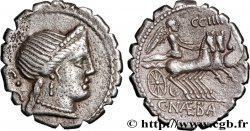
brm_178022 - NAEVIA Denier serratus

No disponible.
Artículo vendido en nuestra tienda
Precio : 45.00 €
Artículo vendido en nuestra tienda
Precio : 45.00 €
Tipo : Denier serratus
Fecha: 79 AC.
Nombre del taller / ciudad: Rome ou Italie
Metal: plata
Milésimas de pureza : 950 ‰
Diámetro: 18,5 mm
Eje de acuñación: 5 h.
Peso: 3,34 g.
Comentarios sobre el estado de conservación:
Exemplaire à l’usure régulière. A été nettoyé. Droit décentré
N° en los catálogos de referencia :
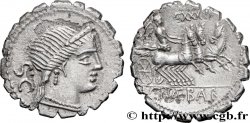
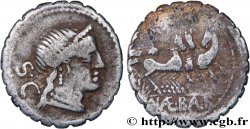
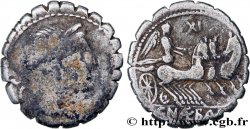
Anverso
Titulatura del anverso: S. C.
Descripción del anverso: Tête diadémée de Vénus à droite ; marque de contrôle A.
Traducción del anverso: “Senatus Consulto”, (avec l’accord du Sénat).
Reverso
Titulatura del reverso: CNÆ B(AL)B.
Descripción del reverso: Victoire dans un trige galopant à droite, tenant les rênes des deux mains à gauche ; au-dessus, marque de contrôle VII, (7).
Traducción del reverso: “Cnæus [Nævius] Balbus”, (Gneius [Nævius] Balbus).
Comentario
Poids léger. La représentation du trige est aussi rare dans les numismatiques gauloise que romaine. On trouve dans l'ouvrage de LA TOUR (LT. 10074, 10075 et 10085), les dessins de trois deniers copiés ou imités sur ce prototype par les Celtes du Danube. D'autre part, S. Scheers donne comme prototype du bronze véliocasse (LT. 7356), le denier de Jules César (RCV. 1402) avec Énée fuyant Troie. En réalité, la tête de Vénus de notre denier semble assez proche de celle du bronze et pourrait lui avoir servi de modèle.
Light weight. The representation of the trige is as rare in Gallic as in Roman numismatics. In the work of LA TOUR (LT. 10074, 10075 and 10085), we find the drawings of three denarii copied or imitated on this prototype by the Celts of the Danube. On the other hand, S. Scheers gives as prototype of the bronze veliocasses (LT. 7356), the denarius of Julius Caesar (RCV. 1402) with Aeneas fleeing Troy. In reality, the head of Venus of our denarius seems quite close to that of the bronze and could have served as a model for it
Light weight. The representation of the trige is as rare in Gallic as in Roman numismatics. In the work of LA TOUR (LT. 10074, 10075 and 10085), we find the drawings of three denarii copied or imitated on this prototype by the Celts of the Danube. On the other hand, S. Scheers gives as prototype of the bronze veliocasses (LT. 7356), the denarius of Julius Caesar (RCV. 1402) with Aeneas fleeing Troy. In reality, the head of Venus of our denarius seems quite close to that of the bronze and could have served as a model for it
Historial
NAEVIA
(79 aC)
La gens Naevia es una familia de origen plebeyo y patricio. Caius Naevius Balbus, el moneyer, es partidario de Sila.
 Informar de un error
 Imprimir la página
 Comparte mi selección
 Haz una pregunta
 Consignar / vender
Artículos relacionados
 Descriptivo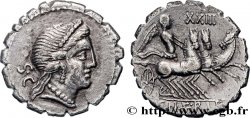

Productos que has visto recientemente
3 Pence INGLATERRA 1948 P.M016a MBC
5.00 €
100 Dinars ARGELIA 1964 P.125a SC
100.00 €

SALONINA Antoninien MBC
15.00 €

GALERIO Follis ou nummus MBC+
100.00 €

VALERIA Follis MBC
70.00 €
CRISPO Centenionalis ou nummus SC/MBC+
120.00 €
cgbfr.es numismàtica


