


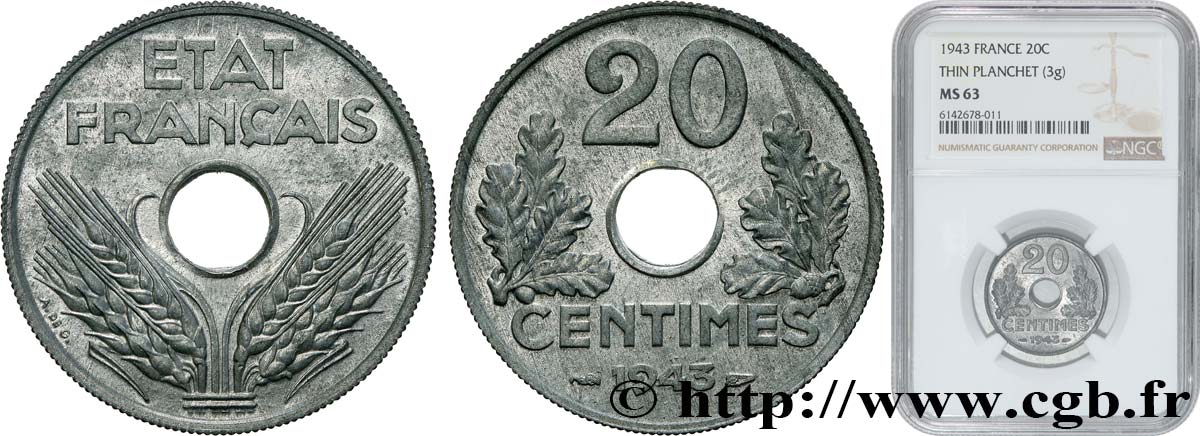
Live auction - fmd_679066 - Pré-série sans le mot ESSAI de 20 centimes État français, légère, poids léger (2,88 g) 1943 F.153A/1 var.
Usted debe firmar y ser un comprador aprobado para pujar, Inicia sesión para pujar. Las cuentas están sujetas a la aprobación y el proceso de aprobación se alcanzan dentro de las 48 horas. No espere hasta el día en una venta se cierra el registro.Al hacer una oferta en este artículo usted está firmando un contrato jurídicamente vinculante para comprar este artículo y haga clic en «oferta» constituye una aceptación de los términos de uso de live auctions de cgb.fr.
La subasta debe ser colocado en euros enteros cantidades venta only.The se cerrará en el momento en la descripción del artículo, no se ejecutarán las ofertas recibidas en el sitio después de la hora de cierre. Veces Transmition pueden variar y las ofertas pueden ser rechazadas si espera a los últimos segundos. Para más información envie el FAQ Live auction.
Las ofertas ganadoras estarán sometidas a un 18% IVA incluido por gastos de participación a la venta.
Las ofertas ganadoras estarán sometidas a un 18% IVA incluido por gastos de participación a la venta.
| Valoración : | 200 € |
| Precio : | 116 € |
| Oferta más alta : | 200 € |
| Fecha de fin de la venta : | 05 septiembre 2023 18:53:21 |
| participantes : | 3 participantes |
Tipo : Pré-série sans le mot ESSAI de 20 centimes État français, légère, poids léger (2,88 g)
Fecha: 1943
Cantidad acuñada: ---
Metal: cinc
Diámetro: 24 mm
Eje de acuñación: 6 h.
Peso: 2,88 g.
Canto: cannelures fines
Grado de rareza: R3
Slab

NGC : MS63
Comentarios sobre el estado de conservación:
Sous coque NGC MS63, Thin Planchet
N° en los catálogos de referencia :
Pedigrí:
Cet exemplaire provient de la Collection Michel
Anverso
Titulatura del anverso: ETAT FRANÇAIS.
Descripción del anverso: Au-dessus d'épis posés sur un cartouche ; trou de perforation.
Reverso
Titulatura del reverso: 20/ CENTIMES/ 1943.
Descripción del reverso: Entre deux branches de chêne.
Comentario
Toutes les 20 centimes État français contenues dans la Collection Michel ont pour point commun d’avoir une masse comprise aux alentours de 2.80 g. Par un effet du hasard (qui n'en est pas un) les exemplaires de la Collection PIERRE se situent à 3 g comme par exemple pour l'exemplaire suivant : https://www.cgb.fr/20-centimes-etat-francais-frappe-courante-1943-paris-f-153a-1-spl,v30_1159,a.html.
L'explication concernant les exemplaires de 2,8 g et de 3 g se trouve dans les archives de La Monnaie de Paris et à la page 832 de l'ouvrage “LE FRANC LES MONNAIES, LES ARCHIVES 2019” de Philippe Théret, le PV associé du 19 JUIN 1943 si situant en bas de page. L'alliage utilisé pour la réalisation des frappes est un zinc alu et il est précisé que les coins courants ont été utilisés (absence du mot essai). Les frappes ont donc été réalisées les 19 et 22 Juin 1943 sous la forme d'essais industriels (définition exacte d'une pré-série) sans le mot essai.
Le tirage réel est indiqué sur le PV:
- 3 g : 19 502 unités
- 2,8 g : 21 363 unités
Le modèle de 2,8 g n'ayant pas été retenu, l'ensemble du tirage a été cisaillé sauf 40 exemplaires et par conséquent un indice de rareté R3 est bien mérité pour l'ensemble des survivants. Le modèle de 3 g est donc de fait plus commun, la pré-série impossible à identifier par rapport au tirage normal qui a suivi.
Il est à noter que l'exemplaire actuellement en vente est lourd (2,88 g) pour un modèle 2,8 g mais la tolérance est large pour ce type (plus ou moins 5%) ce qui donne un modèle très léger jusqu'à 2,94 g. Le modèle léger de 3 g peut descendre jusqu'à 2,85 g. Ainsi le doute peut être permis pour cet exemplaire mais l'appartenance à la collection MICHEL peut permettre de le lever.
All the 20 centime French State coins contained in the Michel Collection have in common a mass of around 2. 80 g. By chance (which is not one) the examples of the PIERRE Collection are at 3 g as for example for the following example: https://www. cgb. fr/20-centimes-state-french-current-minted-1943-paris-f-153a-1-spl,v30_1159,a. html.
The explanation concerning the 2.8 g and 3 g examples can be found in the archives of La Monnaie de Paris and on page 832 of the work “LE FRANC LES MONNAIES, LES ARCHIVES 2019” by Philippe Théret, the associated PV of June 19, 1943 is located at the bottom of the page. The alloy used for the production of the strikes is zinc aluminum and it is specified that the standard dies were used (absence of the word test). The strikes were therefore carried out on June 19 and 22, 1943 in the form of industrial tests (exact definition of a pre-series) without the word test.
The actual mintage is indicated on the PV: - 3 g: 19,502 units - 2.8 g: 21,363 units The 2.8 g model not having been retained, the entire mintage was sheared except for 40 examples and consequently a rarity index R3 is well deserved for all the survivors. The 3g model is therefore in fact more common, the pre-series impossible to identify compared to the normal print run that followed.
It should be noted that the example currently on sale is heavy (2.88 g) for a 2.8 g model but the tolerance is wide for this type (plus or minus 5%) which gives a very light model up to 2.94 g. The lightweight 3g model can drop down to 2.85g. So doubt may be allowed for this example but the fact that it belongs to the MICHEL collection can help to remove it.
L'explication concernant les exemplaires de 2,8 g et de 3 g se trouve dans les archives de La Monnaie de Paris et à la page 832 de l'ouvrage “LE FRANC LES MONNAIES, LES ARCHIVES 2019” de Philippe Théret, le PV associé du 19 JUIN 1943 si situant en bas de page. L'alliage utilisé pour la réalisation des frappes est un zinc alu et il est précisé que les coins courants ont été utilisés (absence du mot essai). Les frappes ont donc été réalisées les 19 et 22 Juin 1943 sous la forme d'essais industriels (définition exacte d'une pré-série) sans le mot essai.
Le tirage réel est indiqué sur le PV:
- 3 g : 19 502 unités
- 2,8 g : 21 363 unités
Le modèle de 2,8 g n'ayant pas été retenu, l'ensemble du tirage a été cisaillé sauf 40 exemplaires et par conséquent un indice de rareté R3 est bien mérité pour l'ensemble des survivants. Le modèle de 3 g est donc de fait plus commun, la pré-série impossible à identifier par rapport au tirage normal qui a suivi.
Il est à noter que l'exemplaire actuellement en vente est lourd (2,88 g) pour un modèle 2,8 g mais la tolérance est large pour ce type (plus ou moins 5%) ce qui donne un modèle très léger jusqu'à 2,94 g. Le modèle léger de 3 g peut descendre jusqu'à 2,85 g. Ainsi le doute peut être permis pour cet exemplaire mais l'appartenance à la collection MICHEL peut permettre de le lever.
All the 20 centime French State coins contained in the Michel Collection have in common a mass of around 2. 80 g. By chance (which is not one) the examples of the PIERRE Collection are at 3 g as for example for the following example: https://www. cgb. fr/20-centimes-state-french-current-minted-1943-paris-f-153a-1-spl,v30_1159,a. html.
The explanation concerning the 2.8 g and 3 g examples can be found in the archives of La Monnaie de Paris and on page 832 of the work “LE FRANC LES MONNAIES, LES ARCHIVES 2019” by Philippe Théret, the associated PV of June 19, 1943 is located at the bottom of the page. The alloy used for the production of the strikes is zinc aluminum and it is specified that the standard dies were used (absence of the word test). The strikes were therefore carried out on June 19 and 22, 1943 in the form of industrial tests (exact definition of a pre-series) without the word test.
The actual mintage is indicated on the PV: - 3 g: 19,502 units - 2.8 g: 21,363 units The 2.8 g model not having been retained, the entire mintage was sheared except for 40 examples and consequently a rarity index R3 is well deserved for all the survivors. The 3g model is therefore in fact more common, the pre-series impossible to identify compared to the normal print run that followed.
It should be noted that the example currently on sale is heavy (2.88 g) for a 2.8 g model but the tolerance is wide for this type (plus or minus 5%) which gives a very light model up to 2.94 g. The lightweight 3g model can drop down to 2.85g. So doubt may be allowed for this example but the fact that it belongs to the MICHEL collection can help to remove it.
Historial
ETAT FRANÇAIS
(10/07/1940-26/08/1944)
Nacido del colapso de la Tercera República tras la derrota francesa de mayo-junio de 1940, el Estado francés fue fundado por votación del Parlamento reunido en la Asamblea Nacional en Vichy el 10 de julio de 1940.. La Asamblea Nacional por 569 a favor, 80 en contra y 17 abstenciones otorga "todos los poderes al gobierno de la República, bajo la autoridad y firma del Mariscal Pétain, con el fin de promulgar por una o más leyes una nueva constitución del 'Estado francés ". Esta constitución debe “garantizar los derechos de Trabajo, Familia y Patria”. Por seis leyes de 1940, se suprime la presidencia de la República en favor del Mariscal Pétain, jefe del Estado francés.. Se crea una corte suprema de justicia. El mariscal Pétain ejerce plenos poderes no sólo gubernamentales sino también legislativos ya que nombra y destituye a los ministros, y los nombra para todos los cargos civiles o militares.. También tiene justicia y fuerza armada. Negocia y ratifica tratados.. A partir de 1941, todos los funcionarios públicos deben prestar juramento al Jefe de Estado. Una reforma moral e intelectual aborda el divorcio, el aborto, el alcoholismo, prohíbe la masonería y crea un Comisariado de Asuntos Judíos. Los sindicatos son abolidos y reemplazados por un sistema corporativo.. Se mantiene a la familia y se instituye la jubilación de los trabajadores. La entrevista de Montoire del 24 de octubre de 1940 compromete a Francia en el camino de la colaboración que se hace total a partir de junio de 1941 con los ataques de la resistencia comunista.. El Estado francés también se compromete junto a Alemania en una cruzada antibolchevique. Tras la progresiva pérdida del Imperio, la zona sur es ocupada por los alemanes provocando el hundimiento de la flota en Toulon.. Con la creación del Servicio de Trabajo Obligatorio (S. T. O. ), la resistencia ve aumentar sus filas. Aumentan los ataques, y su represión, mientras se forma el Consejo Nacional de Resistencia. El desembarco y los levantamientos de la resistencia permiten al Gobierno Provisional de la República Francesa aumentar su control. El 20 de agosto de 1944, los alemanes llevaron al mariscal Pétain a Sigmaringen.. El día 25, la división Leclerc fue la primera en entrar en París en estado de insurrección, dando así la campanada de muerte del régimen de Vichy..
 Informar de un error
 Imprimir la página
 Comparte mi selección
 Haz una pregunta
 Consignar / vender
Artículos relacionados

 Descriptivo


Productos que has visto recientemente
GALLIA - BELGICA - BELLOVACI (Región de Beauvais) Quart de statère d'or à l'a
750.00 €

LOUIS XIV "THE SUN KING" Douzième d'écu, portrait apollinien 1660 Bordeaux BC
150.00 €
Pré-série sans le mot ESSAI de 20 centimes État français, légère, poids lÃ
116.00 €
1 franc Napoléon Ier tête laurée, Empire français 1812 Paris F.205/42 BC25
73.00 €

REINO UNIDO (TOKENS) 1/2 Penny Londres (Middlesex) Francis Shackelton, fabricant
90.00 €
CHARLES VI "THE MAD" OR "THE WELL-BELOVED" Double tournois n.d. Toulouse MBC+
102.90 €
cgbfr.es numismàtica


