


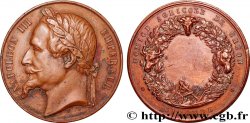
fme_505458 - SEGUNDO IMPERIO FRANCES Médaille, Naissance du prince impérial

No disponible.
Artículo vendido en nuestra tienda (2019)
Precio : 25.00 €
Artículo vendido en nuestra tienda (2019)
Precio : 25.00 €
Tipo : Médaille, Naissance du prince impérial
Fecha: 1856
Metal: cobre
Diámetro: 27,5 mm
Eje de acuñación: 12 h.
Peso: 4,57 g.
Canto: lisse
Cuño: sans poinçon
Grado de rareza: R1
Comentarios sobre el estado de conservación:
Patine hétérogène. Restes de brillant autour des reliefs
N° en los catálogos de referencia :
Anverso
Titulatura del anverso: AUGUSTE PRINCE QUE DIEU ETENDE SUR TOI SA PROTECTION DIVINE.
Descripción del anverso: Un ange au-dessus du berceau impérial avec une étoile rayonnante.
Reverso
Titulatura del reverso: NAPOLEON / EUGENE LOUIS / JEAN JOSEPH / PRINCE IMPAL / - / NÉ / LE 16 MARS / 1856..
Descripción del reverso: Légende en 7 lignes, deux branches de laurier au niveau du trait.
Comentario
Wikipedia nous informe de la cérémonie :
L'arrivée au monde de cet héritier fut pénible pour l'impératrice Eugénie qui a beaucoup souffert en lui donnant la vie. Il fallut recourir aux fers dont l'enfant porta au front les traces. Pour la naissance du prince, la ville de Paris lui offrit un berceau aux armes de l'Empire (ce berceau est toujours visible au musée Carnavalet à Paris).
Le 14 juin 1856, le prince impérial fut baptisé en grande pompe à Notre-Dame de Paris. Napoléon III dit de la cérémonie et des réjouissances qui s'en suivirent : « Un tel baptème vaut bien un sacre.» La famille impériale fut conduite dans le carrosse qui servit à Reims, lors du sacre de Charles X. Le parrain est le pape Pie IX et la marraine est la reine Victoria d'Angleterre. Cependant, celle-ci étant de religion anglicane, c'est la reine de Suède, Joséphine, fille d'Eugène de Beauharnais, cousine de l'empereur, qui la représente. Le pape se fit représenter par le cardinal-légat Patrizzi, qui baptisa l'enfant.
Dans l'acte officiel, conservé sur le registre des baptêmes de l'église Saint-Germain-l'Auxerrois, dont dépendait la chapelle des Tuileries, il fut déclaré "fils de France", titre que Napoléon Ier avait utilisé pour son fils, le roi de Rome, et repris de l'Ancien régime. Il fut question de lui donner un titre royal, celui de Roi d'Alger, mais cette idée fut abandonnée.
La suite à http://fr.wikipedia.org/wiki/Louis_Napol%C3%A9on_Bonaparte_%28Prince_imp%C3%A9rial%29.
Wikipedia tells us about the ceremony: The arrival of this heir was painful for Empress Eugenie, who suffered greatly in giving birth to him.. It was necessary to resort to irons, the marks of which were left on the child's forehead.. For the birth of the prince, the city of Paris offered him a cradle bearing the coat of arms of the Empire (this cradle can still be seen at the Carnavalet Museum in Paris).
On June 14, 1856, the Prince Imperial was baptized with great pomp at Notre-Dame de Paris.. Napoleon III said of the ceremony and the festivities that followed: \\\"Such a baptism is well worth a coronation.\\\". \\\"The imperial family was driven in the carriage that was used in Reims during the coronation of Charles X. The godfather is Pope Pius IX and the godmother is Queen Victoria of England. However, since she was of the Anglican religion, it was the Queen of Sweden, Josephine, daughter of Eugène de Beauharnais, cousin of the Emperor, who represented her.. The Pope was represented by Cardinal Legate Patrizzi, who baptized the child.
In the official document, preserved in the baptismal register of the church of Saint-Germain-l'Auxerrois, on which the chapel of the Tuileries depended, he was declared \\\"son of France\\\", a title that Napoleon I had used for his son, the King of Rome, and taken from the Ancien Régime. There was talk of giving him a royal title, that of King of Algiers, but this idea was abandoned..
Continued at http://fr. Wikipedia. org/wiki/Louis_Napol%C3%A9on_Bonaparte_%28Prince_imp%C3%A9rial%29
L'arrivée au monde de cet héritier fut pénible pour l'impératrice Eugénie qui a beaucoup souffert en lui donnant la vie. Il fallut recourir aux fers dont l'enfant porta au front les traces. Pour la naissance du prince, la ville de Paris lui offrit un berceau aux armes de l'Empire (ce berceau est toujours visible au musée Carnavalet à Paris).
Le 14 juin 1856, le prince impérial fut baptisé en grande pompe à Notre-Dame de Paris. Napoléon III dit de la cérémonie et des réjouissances qui s'en suivirent : « Un tel baptème vaut bien un sacre.» La famille impériale fut conduite dans le carrosse qui servit à Reims, lors du sacre de Charles X. Le parrain est le pape Pie IX et la marraine est la reine Victoria d'Angleterre. Cependant, celle-ci étant de religion anglicane, c'est la reine de Suède, Joséphine, fille d'Eugène de Beauharnais, cousine de l'empereur, qui la représente. Le pape se fit représenter par le cardinal-légat Patrizzi, qui baptisa l'enfant.
Dans l'acte officiel, conservé sur le registre des baptêmes de l'église Saint-Germain-l'Auxerrois, dont dépendait la chapelle des Tuileries, il fut déclaré "fils de France", titre que Napoléon Ier avait utilisé pour son fils, le roi de Rome, et repris de l'Ancien régime. Il fut question de lui donner un titre royal, celui de Roi d'Alger, mais cette idée fut abandonnée.
La suite à http://fr.wikipedia.org/wiki/Louis_Napol%C3%A9on_Bonaparte_%28Prince_imp%C3%A9rial%29.
Wikipedia tells us about the ceremony: The arrival of this heir was painful for Empress Eugenie, who suffered greatly in giving birth to him.. It was necessary to resort to irons, the marks of which were left on the child's forehead.. For the birth of the prince, the city of Paris offered him a cradle bearing the coat of arms of the Empire (this cradle can still be seen at the Carnavalet Museum in Paris).
On June 14, 1856, the Prince Imperial was baptized with great pomp at Notre-Dame de Paris.. Napoleon III said of the ceremony and the festivities that followed: \\\"Such a baptism is well worth a coronation.\\\". \\\"The imperial family was driven in the carriage that was used in Reims during the coronation of Charles X. The godfather is Pope Pius IX and the godmother is Queen Victoria of England. However, since she was of the Anglican religion, it was the Queen of Sweden, Josephine, daughter of Eugène de Beauharnais, cousin of the Emperor, who represented her.. The Pope was represented by Cardinal Legate Patrizzi, who baptized the child.
In the official document, preserved in the baptismal register of the church of Saint-Germain-l'Auxerrois, on which the chapel of the Tuileries depended, he was declared \\\"son of France\\\", a title that Napoleon I had used for his son, the King of Rome, and taken from the Ancien Régime. There was talk of giving him a royal title, that of King of Algiers, but this idea was abandoned..
Continued at http://fr. Wikipedia. org/wiki/Louis_Napol%C3%A9on_Bonaparte_%28Prince_imp%C3%A9rial%29
Historial
SEGUNDO IMPERIO FRANCES
(12/02/1852-09/04/1870)
Proclamado emperador con el nombre de Napoleón III, Luis Napoleón hizo su entrada solemne en París el 2 de diciembre de 1852.. Se casó con Eugénie Marie de Montijo, una aristócrata española, en enero de 1853.. Su reinado se puede dividir en tres períodos: el Imperio autoritario hasta 1860; el Imperio Liberal de 1860 a 1870 y luego el Imperio Parlamentario en 1870. Durante el Imperio autoritario, Napoleón III ejercía su poder sin compartir, controlaba la prensa mientras los periódicos practicaban la autocensura para evitar su supresión.. Los prefectos ejercen poder ilimitado en los departamentos, los alcaldes, los funcionarios son nombrados por el gobierno. Como bajo el Primer Imperio, la Educación y la Universidad son monitoreadas. Manteniendo los principios fundamentales de la revolución, la soberanía del pueblo se mantiene gracias a la consulta plebiscitaria. En el plano económico, el auge es importante, se desarrolla la industrialización, así como las organizaciones de crédito y las tiendas departamentales.. El prestigio militar aumenta con la Guerra de Crimea, lo que permite a Francia desempeñar un papel internacional.. El ataque de Orsini (enero de 1858) no impide que Francia intervenga en Italia para hacer triunfar el principio de las nacionalidades y permite la unión de Niza y Saboya por el tratado de Turín (marzo de 1860). A partir de 1860, el Imperio avanza hacia más libertades: tratado de libre comercio con Inglaterra, aparición de una oposición débil en el Cuerpo Legislativo, concesión del derecho de huelga (1864), liberalización de la prensa (1868). En el plano internacional, Francia adquiere Nueva Caledonia, Cochinchina y fomenta la excavación del Canal de Suez por parte de Ferdinand de Lesseps. En México, sin embargo, el apoyo a Maximiliano y Austria fue un fracaso. Las elecciones de 1869 fueron muy malas para el régimen y la oposición obtuvo el 45% de los votos. El régimen evolucionó entonces hacia un imperio parlamentario al llamar al poder a Émile Ollivier, líder del partido orleanista y liberal.. Después de Sadowa en 1866 cuando Prusia aplastó a Austria, el asunto del trono de España y el envío de Ems llevaron a la guerra que se declaró el 19 de julio de 1870.. Acumulando reveses, el ejército francés fue rodeado en Metz y luego Napoleón III, enfermo, capituló en Sedan el 2 de septiembre.. Tan pronto como se supo la noticia, Gambetta anunció la decadencia del Imperio, luego se proclamó la República el 4 de septiembre.. Luego, Napoleón III fue llevado cautivo a Hesse y luego partió hacia Kent, donde murió en 1873..
 Informar de un error
 Imprimir la página
 Comparte mi selección
 Haz una pregunta
 Consignar / vender
Artículos relacionados
 Descriptivo

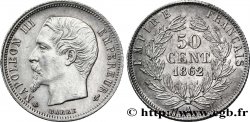


Productos que has visto recientemente

500 Mark ALEMANIA Bielefeld 1921 SC
60.00 €
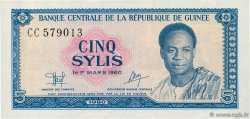
5 Sylis GUINEA 1980 P.22a FDC
22.00 €
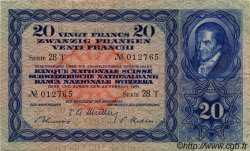
20 Francs SUISSE 1951 P.39s MBC
20.00 €

QUINTA REPUBLICA FRANCESA Médaille, Concours général agricole EBC
50.00 €

PERú 1 Sol Chat des Andes 2019 Lima SC
3.00 €

ISLA DE MAN 1/2 Penny 1839 MBC
65.00 €
cgbfr.es numismàtica


