


brm_605392 - TRAJANO Denier
No disponible.
Artículo vendido en nuestra tienda (2020)
Precio : 150.00 €
Artículo vendido en nuestra tienda (2020)
Precio : 150.00 €
Tipo : Denier
Fecha: 106
Nombre del taller / ciudad: Roma
Metal: plata
Milésimas de pureza : 900 ‰
Diámetro: 17,5 mm
Eje de acuñación: 6 h.
Peso: 3,26 g.
Grado de rareza: R1
Officine: 5e
Comentarios sobre el estado de conservación:
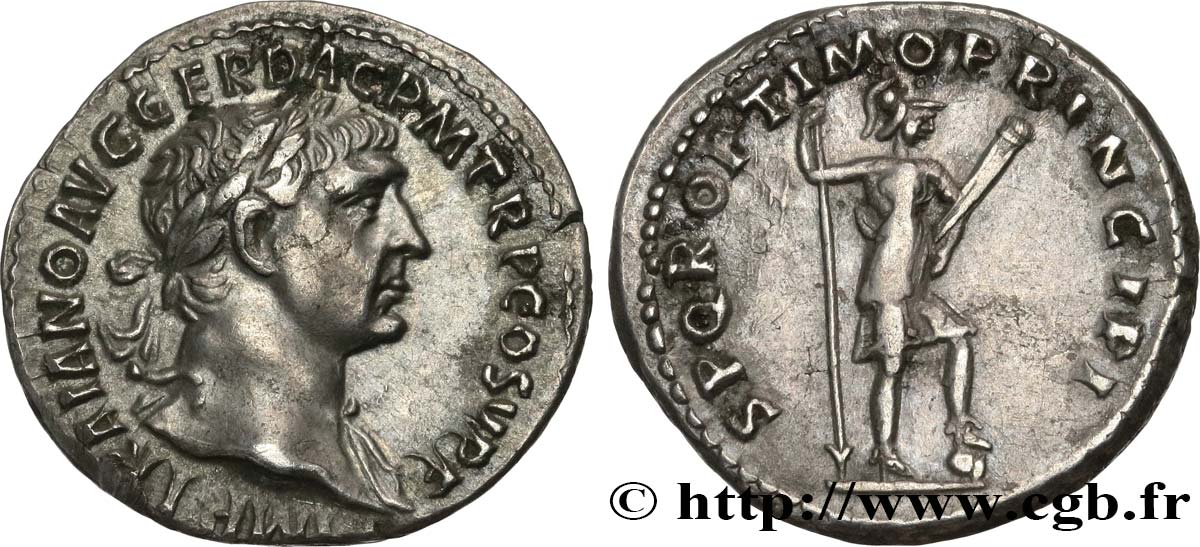
Très bel exemplaire, idéalement centré. Superbe buste. Joli revers. Patine grise
N° en los catálogos de referencia :
Anverso
Titulatura del anverso: IMP TRAIANO AVG GER DAC P M TR P COS V P P.
Descripción del anverso: Tête laurée de Trajan à droite, drapée sur l’épaule gauche (O*2).
Traducción del anverso: “Imperatori Traiano Augusto Germanico Dacico Pontifex Maximus Tribunicia Potestate Consuli quinto, Patri Patriæ”, (À l’empereur Trajan auguste germanique, dacique, grand pontife, revêtu de la puissance tribunitienne, consul pour la cinquième fois, père de la patrie).
Reverso
Titulatura del reverso: S P Q R OPTI-MO PRINCIPI.
Descripción del reverso: Virtus (la Virilité) casquée, vêtue militairement, le pied gauche sur un casque, tenant de la main gauche le parazonium et de la main droite, une haste longue renversée.
Traducción del reverso: “Senatus Populus Que Romanus Optimo Principi”, (Le sénat et le peuple romain, au meilleur des princes).
Comentario
Il revient à l’école anglaise et aux travaux de P. V. Hill, The dating and arrangement of the Undated Coins of Rome AD. 98-148, Londres 1970, d’avoir reclassé les différentes émissions de l’atelier de Rome, grâce à la théorie des cycles et d’avoir mis en lumière l’organisation de l’atelier de Rome qui travaille en officines et non pas en fonction du métal comme l’avaient décrit les numismates du XIXe siècle. Rubans de type 3.
It is the English school and the work of PV Hill, The dating and arrangement of the Undated Coins of Rome AD. 98-148, London 1970, which reclassified the various issues of the Rome mint, thanks to the theory of cycles and to have highlighted the organization of the Rome mint which worked in workshops and not according to the metal as the 19th century numismatists had described. Type 3 ribbons
It is the English school and the work of PV Hill, The dating and arrangement of the Undated Coins of Rome AD. 98-148, London 1970, which reclassified the various issues of the Rome mint, thanks to the theory of cycles and to have highlighted the organization of the Rome mint which worked in workshops and not according to the metal as the 19th century numismatists had described. Type 3 ribbons
Historial
TRAJANO
(27/10/97-8/08/117)
Augusto
Trajano nació el 18 de septiembre de 53 en Itálica, cerca de Sevilla en España, como su discípulo Adriano. Pertenece a una familia de colonos asentados en España. Tras una brillante carrera militar bajo los Flavios, fue cónsul en el 91 y legado de Germania Superior cuando fue adoptado por Nerva en el 97 para sucederle. Después de la muerte de este último, se convierte en augusto. Su reinado estará dedicado a numerosas campañas militares contra los germanos en el limes del Rin, lo que le valió el título de Germánico. Luego, dirigió dos guerras dacias contra Decebalus que terminaron con la anexión de Dacia. Trajano prepara una campaña contra los partos, los turbulentos y poderosos vecinos del este. Dejó Roma para Oriente y estableció su cuartel general en Antioquía antes de invadir el reino parto. Irá hasta Ctesifonte (Seleucia en el Tigris). Cuando murió el 8 de agosto de 117, el Imperio estaba en su apogeo y experimentaba su mayor expansión territorial..
 Informar de un error
 Imprimir la página
 Comparte mi selección
 Haz una pregunta
 Consignar / vender
Artículos relacionados

 Descriptivo


cgbfr.es numismàtica


