


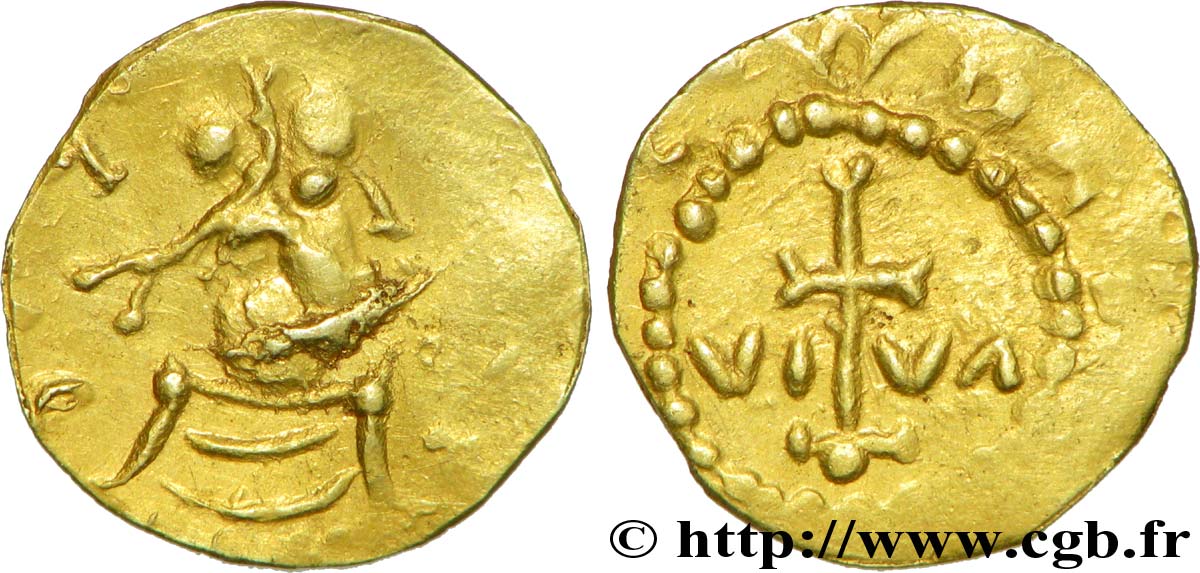
v41_1637 - VIVIERS (VIVARIA CIVITAS) - Ardèche Triens pour DAGOBERTVS REX
MONNAIES 41 (2009)
Precio de inicio : 1 800.00 €
Valoración : 3 000.00 €
lote sin vender
Precio de inicio : 1 800.00 €
Valoración : 3 000.00 €
lote sin vender
Tipo : Triens pour DAGOBERTVS REX
Fecha: 629-639
Nombre del taller / ciudad: VIVIERS
Metal: oro
Diámetro: 13,5 mm
Eje de acuñación: 6 h.
Peso: 0,97 g.
Grado de rareza: R3
Comentarios sobre el estado de conservación:
Très bel exemplaire frappé sur un flan large et en bon or. Type de droit complet et centré, mais avec les légende en bord de flan ou sous un plat de frappe. Revers légèrement décentré avec les légendes incomplètes et difficilement lisibles
N° en los catálogos de referencia :
Anverso
Titulatura del anverso: [DAGOBERT].
Descripción del anverso: Buste diadémé, drapé à droite, légende autour.
Reverso
Titulatura del reverso: (...) ?.
Descripción del reverso: Croix latine sur un degré accostée des lettres VI - VA dans un grènetis intérieur, légende autour.
Comentario
Deux monnaies correspondent à cet exemplaire dont la légende est malheureusement mal venue. Avec ce style de droit et sans l’indication des VII silliques, notre triens est très proche du triens B. 4930 pour Chlothaire Rex et du triens B. 4935 pour Dagobert Rex (exemplaire n° 174 du Musée de Lyon).
Il est regrettable de ne pas avoir plus de collections publiées et photographiées ; la cassure de coin sous le menton aurait sans doute permis de rapprocher avec certitude ce triens à un autre du même coin.
Nous avons ici un monnayage imité des monnaies de Marseille pour la cité de Viviers, siège d'un Évêché depuis le IVe siècle. Sur certains triens, le poids est indiqué au revers dans le champ; il est de 7 siliques contre 8 pour un tremissis byzantin. Le solidus pesait 4 scrupules ou 24 siliques (4,51 g.). En Gaule, le poids du solidus avait été ramené à 21 siliques (3,94 g.). Au VIème siècle le commerce n'a pas cessé entre Byzance et la Gaule, les échanges sont différents, la monnaie circule moins bien. Le commerce maritime est entre les mains des "Syriens", commerçants du monde méditerranéen qui amènent dans la grande cité phocéenne les produits venant d'Orient.
Two coins correspond to this example, the legend of which is unfortunately inappropriate.. With this style of law and without the indication of the VII silliques, our triens is very close to triens B. 4930 for Chlothaire Rex and triens B. 4935 for Dagobert Rex (example no. 174 from the Lyon Museum).
It is a pity that there are not more collections published and photographed; the corner break under the chin would undoubtedly have made it possible to reliably compare this triens to another from the same corner..
Here we have a coinage imitated from the coins of Marseille for the city of Viviers, seat of a Bishopric since the 4th century.. On some trien, the weight is indicated on the reverse in the field; it is 7 siliquae against 8 for a Byzantine tremissis. The solidus weighed 4 scruples or 24 siliquae (4.51 g. ). In Gaul, the weight of the solidus had been reduced to 21 siliquae (3.94 g. ). In the 6th century, trade between Byzantium and Gaul continued; exchanges were different and coin circulated less well.. Maritime trade was in the hands of the \\\"Syrians\\\", traders from the Mediterranean world who brought products from the East to the great Phocaean city.
Il est regrettable de ne pas avoir plus de collections publiées et photographiées ; la cassure de coin sous le menton aurait sans doute permis de rapprocher avec certitude ce triens à un autre du même coin.
Nous avons ici un monnayage imité des monnaies de Marseille pour la cité de Viviers, siège d'un Évêché depuis le IVe siècle. Sur certains triens, le poids est indiqué au revers dans le champ; il est de 7 siliques contre 8 pour un tremissis byzantin. Le solidus pesait 4 scrupules ou 24 siliques (4,51 g.). En Gaule, le poids du solidus avait été ramené à 21 siliques (3,94 g.). Au VIème siècle le commerce n'a pas cessé entre Byzance et la Gaule, les échanges sont différents, la monnaie circule moins bien. Le commerce maritime est entre les mains des "Syriens", commerçants du monde méditerranéen qui amènent dans la grande cité phocéenne les produits venant d'Orient.
Two coins correspond to this example, the legend of which is unfortunately inappropriate.. With this style of law and without the indication of the VII silliques, our triens is very close to triens B. 4930 for Chlothaire Rex and triens B. 4935 for Dagobert Rex (example no. 174 from the Lyon Museum).
It is a pity that there are not more collections published and photographed; the corner break under the chin would undoubtedly have made it possible to reliably compare this triens to another from the same corner..
Here we have a coinage imitated from the coins of Marseille for the city of Viviers, seat of a Bishopric since the 4th century.. On some trien, the weight is indicated on the reverse in the field; it is 7 siliquae against 8 for a Byzantine tremissis. The solidus weighed 4 scruples or 24 siliquae (4.51 g. ). In Gaul, the weight of the solidus had been reduced to 21 siliquae (3.94 g. ). In the 6th century, trade between Byzantium and Gaul continued; exchanges were different and coin circulated less well.. Maritime trade was in the hands of the \\\"Syrians\\\", traders from the Mediterranean world who brought products from the East to the great Phocaean city.
Historial
VIVIERS (VIVARIA CIVITAS) - Ardèche
(siglo VI - VII)
Provenza se mantuvo relativamente independiente hasta el reinado de Théodebert, quien la recuperó de los godos. Para Viviers, Belfort enumera las imitaciones a nombre de IVSTINVS, MAVRICIVS TIBERIVS, HERACLIVS, CHLOTARIVS, DAGOBERTVS y SIGIBERTVS.
 Informar de un error
 Imprimir la página
 Comparte mi selección
 Haz una pregunta
 Consignar / vender
Productos que has visto recientemente

5000 Francs Épreuve FRENCH PACIFIC TERRITORIES 1996 P.03p EBC+
20.00 €

1000 Francs DÉESSE DÉMÉTER Épreuve FRANCIA 1942 F.40.00e EBC
1400.00 €
50 Francs TRÉSOR FRANÇAIS FRANCIA 1947 VF.31.03 MBC+
210.00 €

1000 Francs CÉRÈS ET MERCURE FRANCIA 1930 F.37.05 MBC
33.00 €

10 Dollars EAST CARIBBEAN STATES 1985 P.23k1 FDC
68.00 €
VIVIERS (VIVARIA CIVITAS) - Ardèche Triens pour DAGOBERTVS REX MBC+
1800.00 €
cgbfr.es numismàtica


