


brm_356081 - ACILIA Denier
No disponible.
Artículo vendido en nuestra tienda (2017)
Precio : 150.00 €
Artículo vendido en nuestra tienda (2017)
Precio : 150.00 €
Tipo : Denier
Fecha: 49 AC.
Nombre del taller / ciudad: Grèce ou Illyrie
Metal: plata
Milésimas de pureza : 950 ‰
Diámetro: 18 mm
Eje de acuñación: 6 h.
Peso: 3,93 g.
Grado de rareza: R1
Comentarios sobre el estado de conservación:
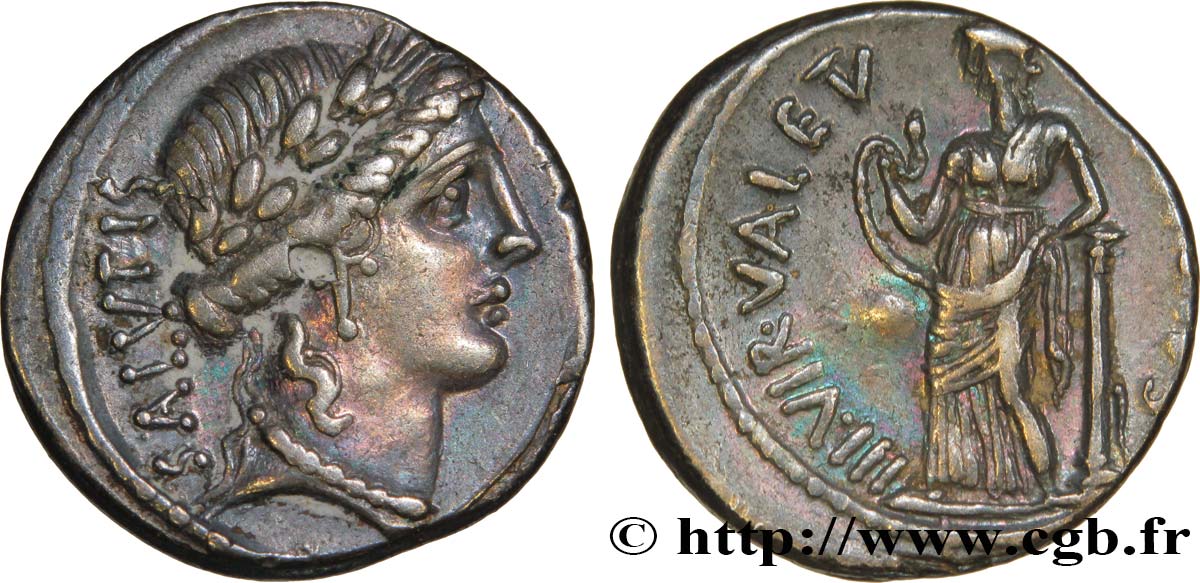
Exemplaire sur un flan ovale. Joli portrait de style fin. Patine grise de collection ancienne
N° en los catálogos de referencia :
Anverso
Titulatura del anverso: SALVTIS.
Descripción del anverso: Tête de Salus (la Santé) laurée à droite.
Traducción del anverso: “Salutis”, (de la Santé).
Reverso
Titulatura del reverso: (MN) ACILIVS/ III VIR VALE(TV).
Descripción del reverso: Valetudo (la Santé) debout à gauche, appuyée sur une colonne de la main gauche et tenant un serpent de la main droite.
Traducción del reverso: “Manius Acilius Triumviri Valetudinis”, (Manius Acilius triumvir monétaire Valetudo).
Comentario
Si le poids est correct, la monnaie semble toute de même fourrée avec notamment une boursouflure de métal au revers. Pour ce type, M. Crawford a relevé une estimation de 651 coins de droit et de 723 coins de revers ce qui pourrait correspondre à une fabrication totale comprise entre un million et demi et trois millions de deniers. C’est l’un des types monétaires qui permit de financer le parti sénatorial au début de l’année 49 avant J.-C. quand ce dernier rejoignit Pompée qui avait quitté Rome. Les auteurs du Catàlogo ont différencié trois variétés dont la nôtre qui semble la plus rare avec le mot SALVTIS qui remonte vers le haut derrière la tête.
If the weight is correct, the coin still seems to be filled, notably with a metal bulge on the reverse. For this type, Mr. Crawford noted an estimate of 651 obverse dies and 723 reverse dies, which could correspond to a total production of between one and a half and three million denarii. This is one of the monetary types that allowed the financing of the senatorial party at the beginning of 49 BC when the latter joined Pompey who had left Rome. The authors of the Catàlogo differentiated three varieties, including ours, which seems the rarest, with the word SALVTIS rising upwards behind the head.
If the weight is correct, the coin still seems to be filled, notably with a metal bulge on the reverse. For this type, Mr. Crawford noted an estimate of 651 obverse dies and 723 reverse dies, which could correspond to a total production of between one and a half and three million denarii. This is one of the monetary types that allowed the financing of the senatorial party at the beginning of 49 BC when the latter joined Pompey who had left Rome. The authors of the Catàlogo differentiated three varieties, including ours, which seems the rarest, with the word SALVTIS rising upwards behind the head.
Historial
ACILIA
(49 aC)
La gens Acilia es una familia plebeya de Roma. Manius Acilius es el hijo de Manius Acilius Glabrio y Æmilia, la hija de Metella y Marcus Æmilius Scaurus. Metella se casa con Sylla en segundas nupcias. Murió en el 82 aC Emilia fue elegida para ser la esposa de Pompeyo, aunque ya estaba casada con Glabrio. Murió en el 81 a.C..
 Informar de un error
 Imprimir la página
 Comparte mi selección
 Haz una pregunta
 Consignar / vender
 Descriptivo


Productos que has visto recientemente

CARACALLA Denier MBC+
150.00 €

ANTONINO PIO Denier MBC+
95.00 €
ACILIA Denier MBC+
150.00 €
TRAJANO Dupondius MBC+
450.00 €
ETRUSCILLA Antoninien EBC
100.00 €
LETONIA 2 Lati 1926 MBC
20.00 €
cgbfr.es numismàtica


