


E-auction 102-53629 - bpv_295222 - SIRIA - PROVINCIA ROMANA - CAIUS CASSIUS LONGINUS Tétradrachme syro-phénicien
Usted debe firmar y ser un comprador aprobado para pujar, Inicia sesión para pujar. Las cuentas están sujetas a la aprobación y el proceso de aprobación se alcanzan dentro de las 48 horas. No espere hasta el día en una venta se cierra el registro.Al hacer una oferta en este artículo usted está firmando un contrato jurídicamente vinculante para comprar este artículo y haga clic en «oferta» constituye una aceptación de los términos de uso de e-auctions de cgb.fr.
La subasta debe ser colocado en euros enteros cantidades venta only.The se cerrará en el momento en la descripción del artículo, no se ejecutarán las ofertas recibidas en el sitio después de la hora de cierre. Veces Transmition pueden variar y las ofertas pueden ser rechazadas si espera a los últimos segundos. Para más información envie el FAQ.
SIN GASTOS PARA LOS COMPRADORES.
SIN GASTOS PARA LOS COMPRADORES.
| Valoración : | 140 € |
| Precio : | 43 € |
| Oferta más alta : | 51 € |
| Fecha de fin de la venta : | 30 marzo 2015 16:01:30 |
| participantes : | 8 participantes |
Tipo : Tétradrachme syro-phénicien
Fecha: 43-42 AC.
Nombre del taller / ciudad: Antioche, Syrie, Séleucie et Piérie
Metal: plata
Diámetro: 26 mm
Eje de acuñación: 12 h.
Peso: 13,80 g.
Grado de rareza: R1
Comentarios sobre el estado de conservación:
Flan court, date certaine mais lue par déduction et élimination
N° en los catálogos de referencia :
Pedigrí:
Cet exemplaire est le 0007_011 de la base TSP et provient de la vente Hans M. F. Schulman (26-29 April 1972), lot 287
Anverso
Titulatura del anverso: ANÉPIGRAPHE.
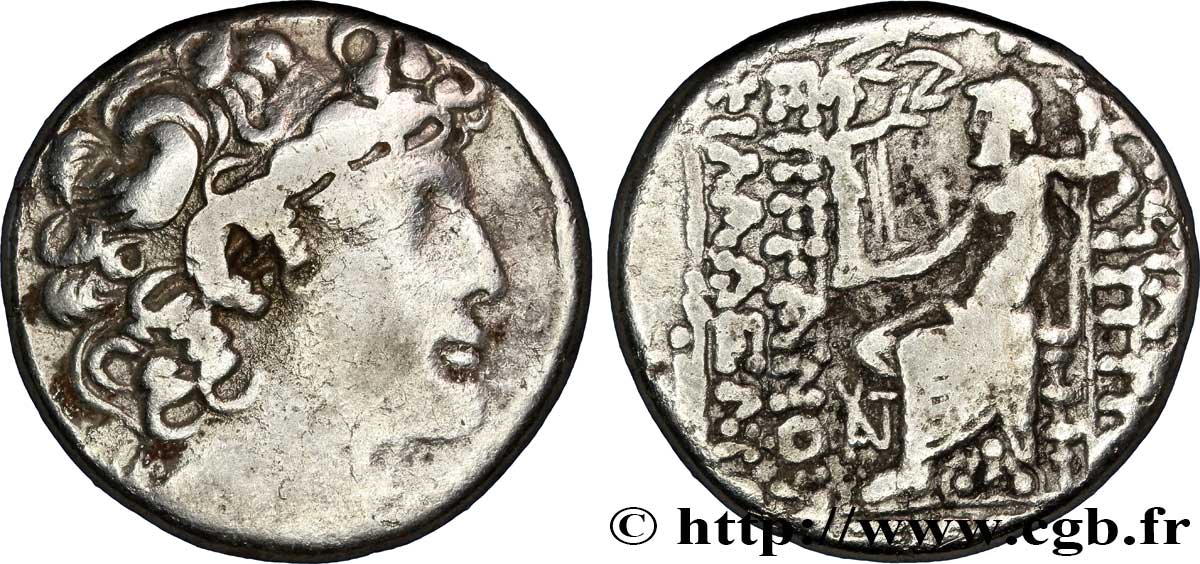
Descripción del anverso: Tête diadémée de Philippe Philadelphe à droite, entouré de la stemma (O’).
Reverso
Descripción del reverso: Zeus assis à gauche sur un trône avec dossier, tenant de la main droite une Niké qui le couronne et un sceptre long de la main gauche ; au-dessus de Zeus, le foudre ; monogramme dans le champ à gauche ; date à l’exergue.
Leyenda del reverso: BASILEWS/ FILIPPOU/ EPIFANOUS/ FILADELFOU, s(Basilews Filippou Epifanous Filadelfou)
Traducción del reverso: (Roi Philippe Epiphane Philadelphe/ monogramme d’Antioche et millésime 6 à l’exergue).
Comentario
An 6 de l’ère césarienne, exemplaire classique de la série intermédiaire entre les frappes séleucides et les frappes impériales syriennes. La colonisation romaine est encore discrète et la prise de contrôle est aimable avec des constructions d’amphithéâtres, des travaux publics et des cérémonies. La monnaie, bien que contrôlée par Rome, reste au type séleucide et seul le petit monogramme indique la prise de pouvoir, ainsi que le millésime, ici l’an 6 de l’ère césarienne.
Notons que l’ère césarienne est conservée pour dater la monnaie, bien que le pouvoir politique à Antioche soit aux mains des Pompéiens.
Style classique pour l’émission avec les mèches traitées en “serpents”.
Les émissions au type immobilisé de Philippe Philadelphe sont très importantes car elles illustrent parfaitement la logique impériale de la colonisation romaine. Autant une conquête de revendication territoriale d'expansion de l'espace vital autour d'un pouvoir central de type national va chercher à éliminer toutes les symboliques locales dans les pays conquis pour imposer celles du conquérant (selon le principe de un peuple, un roi, une foi, une loi), autant un empire va laisser cohabiter des symboliques différentes. C'est ce qui se passe en Syrie, Palestine et Phénicie dans les premiers temps de l'expansion. Loin d'imposer le denier ou la typologie romaine, les Latins vont respecter la métrologie et même le type. Il faudra attendre les rares émissions d'Auguste au revers du Zeus, presque cinquante ans, pour voir apparaître le portrait du Prince sur les monnaies locales en argent.
Dans la base TSP maintenue par Michel Prieur, dix-huit exemplaires sont maintenant répertoriés, dont un à l’ANS.
Year 6 of the Caesarian era, a classic example of the intermediate series between the Seleucid strikes and the Syrian imperial strikes. Roman colonization is still discreet and the takeover is friendly with the construction of amphitheaters, public works and ceremonies. The coin, although controlled by Rome, remains of the Seleucid type and only the small monogram indicates the seizure of power, as well as the year, here the year 6 of the Caesarian era..
Note that the Caesarean era is retained to date the coin, although political power in Antioch was in the hands of the Pompeians.
Classic style for the show with the strands treated in “snakes”.
The immobilized type emissions of Philippe Philadelphe are very important because they perfectly illustrate the imperial logic of Roman colonization.. Just as a conquest of territorial claim of expansion of the living space around a central power of national type will seek to eliminate all local symbols in the conquered countries to impose those of the conqueror (according to the principle of one people, one king, one faith, one law), so an empire will allow different symbols to coexist. This is what happened in Syria, Palestine and Phoenicia in the early days of expansion.. Far from imposing the denarius or Roman typology, the Latins will respect metrology and even the type. It was not until the rare issues of Augustus on the reverse of the Zeus, almost fifty years later, that the portrait of the Prince appeared on local silver coins..
In the TSP database maintained by Michel Prieur, eighteen examples are now listed, including one at the ANS
Notons que l’ère césarienne est conservée pour dater la monnaie, bien que le pouvoir politique à Antioche soit aux mains des Pompéiens.
Style classique pour l’émission avec les mèches traitées en “serpents”.
Les émissions au type immobilisé de Philippe Philadelphe sont très importantes car elles illustrent parfaitement la logique impériale de la colonisation romaine. Autant une conquête de revendication territoriale d'expansion de l'espace vital autour d'un pouvoir central de type national va chercher à éliminer toutes les symboliques locales dans les pays conquis pour imposer celles du conquérant (selon le principe de un peuple, un roi, une foi, une loi), autant un empire va laisser cohabiter des symboliques différentes. C'est ce qui se passe en Syrie, Palestine et Phénicie dans les premiers temps de l'expansion. Loin d'imposer le denier ou la typologie romaine, les Latins vont respecter la métrologie et même le type. Il faudra attendre les rares émissions d'Auguste au revers du Zeus, presque cinquante ans, pour voir apparaître le portrait du Prince sur les monnaies locales en argent.
Dans la base TSP maintenue par Michel Prieur, dix-huit exemplaires sont maintenant répertoriés, dont un à l’ANS.
Year 6 of the Caesarian era, a classic example of the intermediate series between the Seleucid strikes and the Syrian imperial strikes. Roman colonization is still discreet and the takeover is friendly with the construction of amphitheaters, public works and ceremonies. The coin, although controlled by Rome, remains of the Seleucid type and only the small monogram indicates the seizure of power, as well as the year, here the year 6 of the Caesarian era..
Note that the Caesarean era is retained to date the coin, although political power in Antioch was in the hands of the Pompeians.
Classic style for the show with the strands treated in “snakes”.
The immobilized type emissions of Philippe Philadelphe are very important because they perfectly illustrate the imperial logic of Roman colonization.. Just as a conquest of territorial claim of expansion of the living space around a central power of national type will seek to eliminate all local symbols in the conquered countries to impose those of the conqueror (according to the principle of one people, one king, one faith, one law), so an empire will allow different symbols to coexist. This is what happened in Syria, Palestine and Phoenicia in the early days of expansion.. Far from imposing the denarius or Roman typology, the Latins will respect metrology and even the type. It was not until the rare issues of Augustus on the reverse of the Zeus, almost fifty years later, that the portrait of the Prince appeared on local silver coins..
In the TSP database maintained by Michel Prieur, eighteen examples are now listed, including one at the ANS
Historial
SIRIA - PROVINCIA ROMANA - CAIUS CASSIUS LONGINUS
43-42 AC.
Caius Cassius Longinus había sido parte del ejército de Crassus que fue aplastado en Carrhae (mayo del 53 a. C.. -VS. ). Logró escapar de un destino desastroso, reunió a los restos del ejército y organizó la defensa de Siria, donde asumió el cargo de procurador.. Partidario de Pompeyo, César lo perdonó después de Farsalia en el 48 a.. -VS. lo que no le impidió verse envuelto en el complot donde el dictador perdió la vida en los idus de marzo (15 de marzo del 44 a. C.).. -VS. ). Tras la muerte de César y la actitud de Marc Antoine, abandonó Italia y se refugió en Siria. En el 43 a.C.. -VS. , recibió con Bruto, otro asesino de César, un "Imperio" sobre todo Oriente. Siendo este poder solo nominal, Cayo Casio lo aseguró despojando a los judíos ricos de Antioquía para pagar sus tropas y hacerse popular.. El gobernador legítimo, Dollabella, trató de desalojarlo de Antioquía, pero Caius Cassius, en represalia, atacó a Laodicea y empujó a Dollabella al suicidio, luego ocupó Tarso y Rodas.. Por mandato de Octavio, Cassius y Brutus fueron declarados enemigos públicos por la "lex Pedia" en el otoño del mismo año.. Cassius y Brutus unieron fuerzas en Grecia en septiembre del 42 a.. -VS. La reunión final tuvo lugar en Filipos en Macedonia en octubre de 42. Durante la primera pelea, Cassius al verse perdido, prefirió suicidarse..
 Informar de un error
 Imprimir la página
 Comparte mi selección
 Haz una pregunta
 Consignar / vender
Productos que has visto recientemente
SIRIA - PROVINCIA ROMANA - MARCO ANTONIO Tétradrachme syro-phénicien MBC
250.00 €
cgbfr.es numismàtica


