


No disponible.
Artículo vendido en nuestra tienda (2026)
Precio : 320.00 €
Artículo vendido en nuestra tienda (2026)
Precio : 320.00 €
Tipo : Denier
Fecha: c. 15-22
Nombre del taller / ciudad: Lyon
Metal: plata
Milésimas de pureza : 950 ‰
Diámetro: 18 mm
Eje de acuñación: 9 h.
Peso: 3,43 g.
Comentarios sobre el estado de conservación:
Monnaie centrée. Joli portrait de Tibère. Usure régulière. Revers agréable. Patine grise
N° en los catálogos de referencia :
Anverso
Titulatura del anverso: TI CAESAR DIVI - AVG F AVGVSTVS.
Descripción del anverso: Tête laurée de Tibère à droite (O*).
Traducción del anverso: “Tiberius Cæsar Divi Augusti Filius Augustus”, (Tibère César fils du divin Auguste, auguste).
Reverso
Titulatura del reverso: PONTIF - MAXIM.
Descripción del reverso: Pax (la Paix) ou Livie assise à droite sur un siège décoré, tenant une branche d'olivier de la main gauche et de la droite un long sceptre.
Traducción del reverso: “Pontifex Maximus”, (Grand pontife).
Comentario
Monnaie anciennement nettoyée. Comme pour le denier d'Auguste, cette pièce appartient à l'atelier impérial de Lyon et ce type de denier a circulé pendant pratiquement un siècle. Il se rencontre très souvent avec des monnaies gauloises de la phase terminale dans les fouilles archéologiques. C’est la monnaie romaine la plus courante en Gaule pour les Julio-Claudiens. La première émission se caractérise par un socle représenté par deux lignes et les pieds du siège sont droits au revers.
This coin has been cleaned in the past. Like the denarius of Augustus, this coin belongs to the imperial mint of Lyon, and this type of denarius circulated for almost a century. It is very often found alongside Gallic coins from the later period in archaeological excavations. It is the most common Roman coin in Gaul during the Julio-Claudian dynasty. The first issue is characterized by a base represented by two lines, and the legs of the seat are straight on the reverse.
This coin has been cleaned in the past. Like the denarius of Augustus, this coin belongs to the imperial mint of Lyon, and this type of denarius circulated for almost a century. It is very often found alongside Gallic coins from the later period in archaeological excavations. It is the most common Roman coin in Gaul during the Julio-Claudian dynasty. The first issue is characterized by a base represented by two lines, and the legs of the seat are straight on the reverse.
Historial
TIBERIO
(19/08/14-16/03/37)
Augusto
Tiberio, hijo de Tiberio Claudio Nerón y Livia, nació el 16 de noviembre del 42 a.. -VS. Su padre, lugarteniente de César durante la Guerra de Alejandría (48-47 a. C.). -VS. ), luego se reunió con Antoine. Octave secuestró a Livia, la madre de Tiberio, y se casó con ella en el 38 a.. -VS. mientras ella está embarazada por Nero Drusus. Para complicar aún más el árbol genealógico de los julio-claudianos, Tiberio tuvo que divorciarse de Vipsania para casarse con Julie, la hija de Augusto, viuda de Agripa (12 a. C.).. -VS. ). Después de haberlo elegido como heredero, Augusto prefiere a sus nietos y Tiberio se exilia en Rodas.. Después de un intento de complot de Julie, Tibère se divorcia de ella y nunca la volverá a ver.. En 4, Augusto adopta a Tiberio, quien lo sucede en 14. Su reinado durará 23 años.. Germánico, a quien no amaba, murió en 19. Perdió a su hijo Druso en el 23, asesinado por su esposa, Livilla, con la ayuda del prefecto del Pretorio, Séjan, su amante, quien retuvo su poder hasta el 31.. Denunciado por sus crímenes por su cuñada, Antonia, Séjan es ejecutado. Tiberio se retiró a Capri desde el año 27, murió, posiblemente asesinado, en el 37 y le sucedió su sobrino nieto Calígula, bisnieto de Augusto..
 Informar de un error
 Imprimir la página
 Comparte mi selección
 Haz una pregunta
 Consignar / vender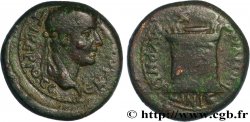
 Descriptivo


Productos que has visto recientemente

TROAS - TENEDOS Hemidrachme MBC
150.00 €

MÍSIA - PARION Trihemidrachme MBC
74.00 €
TRACIA - MARONEIA Tétradrachme MBC+
390.00 €

GETA Assarion BC+/MBC
24.00 €

SEPTIMIO SEVERO pentassaria BC+
280.00 €
SEPTIMIO SEVERO Denier BC
6.00 €
cgbfr.es numismàtica


